-->

Welcome to our Coding with python Page!!! hier you find various code with PHP, Python, AI, Cyber, etc ... Electricity, Energy, Nuclear Power

Showing posts with label #100DaysOfCode. Show all posts

Tuesday, 15 February 2022

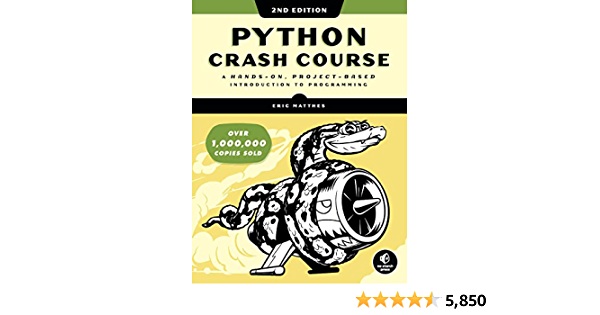
Download Python Crash Course: A Hands-On, Project-Based Introduction to Programming, 2nd Edition

 Python Crash Course, 2nd Edition: A Hands-On, Project-Based Introduction to Programming

Python Crash Course, 2nd Edition: A Hands-On, Project-Based Introduction to Programming


Link - https://fr.b-ok.africa/dl/5416472/bee132

#Python, #100DaysOfCode, #CodeNewbies, #WomenWhoCode, #DevOps, #code, #Coding, #LearnToCode, #DataAnalytics, #DataScience, #MachineLearning, #AI, #programming, 

Wednesday, 20 October 2021

WHAT HAPPENS WHEN BLOCKCHAIN, IOT, AND AI CONVERGE?

All about Agile, Ansible, DevOps, Docker, EXIN, Git, ICT, Jenkins, Kubernetes, Puppet, Selenium, Python, etc

Blockchain, internet of things (IoT), and artificial intelligence (AI) are driving the digital transformation of the post pandemic era.

The inevitable convergence of blockchain, IoT, and AI can form an impactful combination of security, interconnectivity, and autonomy to revolutionize the way things are done.

Synergy’ is a word that refers to a collaboration of entities that creates an impact much greater than that possible by the individual entities on their own. The convergence of blockchain, IoT, and AI is just that - a combination of technologies that have the potential to redefine the way businesses, industries, and even economies function, way more than they are already doing. A few applications and concepts have already seen an overlap between these technologies, with promising results. An example of this is the combination of AI and blockchain to manage UAV air traffic, making mass autonomous flight safer. This application alone, upon materialization, will redefine quite a number of industries like aviation and logistics. Thus, it’s not hard to imagine the impact that the combination of blockchain, IoT, and AI can have on the world. To understand the implications of the coalition of these technologies, it is first important to understand what they individually bring to the table.

Blockchain, IoT and AI Assessed Individually

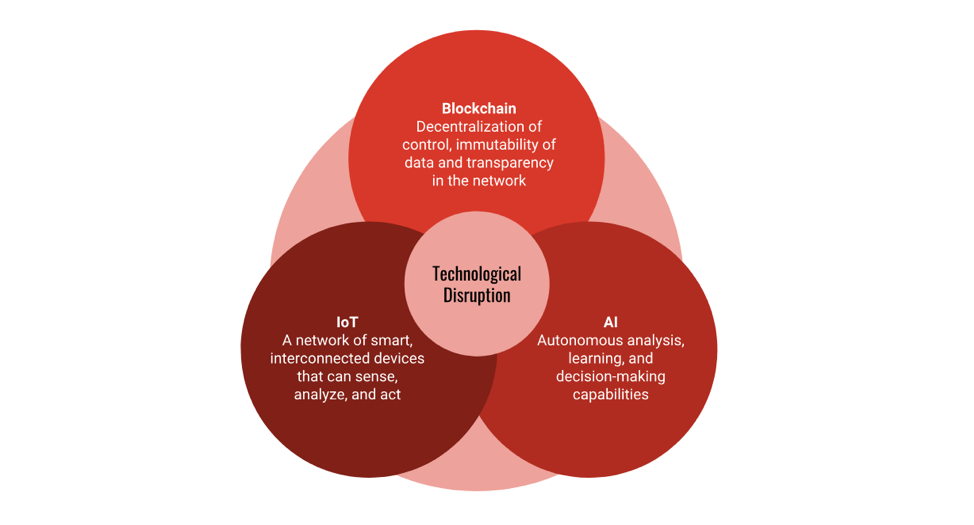
Blockchain_IoT_and_AI_Assessed_Individually.png

Blockchain, the foundational technology for the cryptocurrency Bitcoin, enables a large number of computers to collectively perform computational tasks together and store information in a decentralized, immutable, and universally accessible manner. Various organizations, consortia, as well as industries, are considering using blockchain as a platform for consensus to democratize the decision-making processes among partners. 

The internet of things (IoT) provides seamless interconnectivity among different everyday objects armed with sensors, microprocessors, and transducers to create a network that can independently sense and gather data, continually analyze it, and perform programmed tasks when the situation calls for it. 

Artificial intelligence (AI) gives full autonomy of data analysis, decision-making and action to computers or other smart devices. It can replicate and even exceed human computational and cognitive capabilities under certain conditions, businesses are using AI to automate mainly repetitive, routine processes that may require heavy amounts of data processing and quick decision-making based on pure logic.

Combining Blockchain, IoT, and AI

The convergence of blockchain, IoT, and AI can enable organizations to maximize the benefits of each of these technologies while minimizing the risks and limitations associated with them. As IoT networks comprise a myriad of connected devices, there are numerous vulnerabilities in the network, leaving it prone to hacker attacks, fraud, and data theft. To prevent security issues, AI powered by machine learning can proactively defend against malware and hacker attacks. The security of the network and the data can be further enhanced by blockchain, which can limit illicit access and modification of the data on the network. AI can also enhance the functional capability of the IoT network by making it smarter and more autonomous. 


A potential case that demonstrates the convergence of blockchain, IoT, and AI is Fujitsu’s algorithm to measure workers’ heat stress levels. The algorithm constantly monitors workers’ physiological data such as temperature, humidity, activity levels, pulse, etc. using IoT wearables and sensors to track the correlation between different factors with workers’ health. The analysis can help the company improve working conditions for employees, and prevent them from having severe work-induced health issues. The addition of blockchain to this system can help to keep track of more personalized data by ensuring privacy or can help disburse health insurance amounts using smart contracts. Although the expected impact of the convergence of blockchain, IoT, and AI is exciting to think about, existing applications of these technologies are far from perfect. While 61% of companies claim to have adopted AI, their applications are still in the early stages and nowhere near the levels of sophistication required to achieve real transformation.

The same can be said for IoT and blockchain. However, with increased interest, investment, and innovation, the convergence of blockchain, IoT, and AI will eventually be a reality.

#ArtificialIntelligence #technology #innovation #5G 

#Python #coding #BigData #coding #CyberSecurity #Future #devops #java #CloudComputing #django   #100DaysOfCode #bot #TensorFlow #COVID19 #RHOP #ITC

Machine Learning For Absolute Beginners: A Plain English Introduction

All about Agile, Ansible, DevOps, Docker, EXIN, Git, ICT, Jenkins, Kubernetes, Puppet, Selenium, Python, etc
machine-learning-absolute-beginners-introduction-2nd.pdf

Machine Learning For Absolute Beginners: A Plain English Introduction (Second Edition) (Machine Learning From Scratch Book 1) Kindle Edition

Featured by Tableau as the first of "7 Books About Machine Learning for Beginners."

Ready to spin up a virtual GPU instance and smash through petabytes of data? Want to add 'Machine Learning' to your LinkedIn profile?

Well, hold on there...

Before you embark on your epic journey, there are some high-level theory and statistical principles to weave through first.
But rather than spend $30-$50 USD on a dense long textbook, you may want to read this book first. As a clear and concise alternative to a textbook, this book provides a practical and high-level introduction to machine learning.

Machine Learning for Absolute Beginners Second Edition has been written and designed for absolute beginners. This means plain English explanations and no coding experience required. Where core algorithms are introduced, clear explanations and visual examples are added to make it easy and engaging to follow along at home.

New Updated Edition
This major new edition features many topics not covered in the First Edition, including Cross Validation, Ensemble Modeling, Grid Search, Feature Engineering, and One-hot Encoding. Please note that this book is not a sequel to the First Edition but rather a restructured and revamped version of the First Edition. Readers of the First Edition should not feel compelled to purchase this Second Edition.

Disclaimer: If you have passed the 'beginner' stage in your study of machine learning and are ready to tackle coding and deep learning, you would be well served with a long-format textbook. If, however, you are yet to reach that Lion King moment - as a fully grown Simba looking over the Pride Lands of Africa - then this is the book to gently hoist you up and offer you a clear lay of the land.

In This Step-By-Step Guide You Will Learn:

• How to download free datasets
• What tools and machine learning libraries you need
• Data scrubbing techniques, including one-hot encodingbinning and dealing with missing data
• Preparing data for analysis, including k-fold Validation
• Regression analysis to create trend lines
• Clustering, including k-means clustering, to find new relationships
• The basics of Neural Networks
• Bias/Variance to improve your machine learning model
• Decision Trees to decode classification
• How to build your first Machine Learning Model to predict house values using Python

Frequently Asked Questions

Q: Do I need programming experience to complete this e-book?
A: This e-book is designed for absolute beginners, so no programming experience is required. However, two of the later chapters introduce Python to demonstrate an actual machine learning model, so you will see programming language used in this book.

Q: I have already purchased the First Edition of Machine Learning for Absolute Beginners, should I purchase this Second Edition?
A: As many of the topics from the First Edition are covered in the Second Edition, you may be better served reading a more advanced title on machine learning.

Q: Does this book include everything I need to become a machine learning expert?
A: Unfortunately, no. This book is designed for readers taking their first steps in machine learning and further learning will be required beyond this book to master machine learning.

Please feel welcome to join this introductory course by downloading a copy, or sending a free sample to your chosen device.
#MachineLearning #ML #100DaysOfCode #CodeNewbies #WomenWhoCode #DEVCommunity #DevOps #code #Coding #LearnToCode #Python #Robotics #DataScience #AI #programming

Wednesday, 13 October 2021

You Can Use Artificial Intelligence to Take Your Presentations to the Next Level

All about Agile, Ansible, DevOps, Docker, EXIN, Git, ICT, Jenkins, Kubernetes, Puppet, Selenium, Python, etc

The ability to create killer presentations is an essential skill in the modern workplace. Whether you’re making a pitch to potential investors or business partners, presenting at an industry conference, or simply trying to communicate ideas to your coworkers, a compelling presentation can get people to engage and buy-in, which will ultimately advance your career. So what is the most important factor for a compelling presentation? Obviously, solid public speaking skills are a must. However, in today’s technology-driven world, it is even more important to master the art of visual communication. Research has shown that presentation efficacy is 7-percent content, 38-percent voice, and 55-percent visual. That’s why there are so many design tools and deck templates out there. However, if you want a solution that truly takes your presentations to the next level, you need to check out Beautiful.ai.

WHAT MAKES A GOOD SLIDE DECK?

Presentations
Image via Beautiful.ai

When it comes to visual communication, there are really five basic qualities you want your slide presentation to have. It should feature minimal text that supports rather than repeats what you are saying. It should feature slides with a variety of layouts to avoid monotony and maintain visual interest. It should feature beautiful visuals such as graphs, charts, statistics, and images that support your key takeaways. It should be meticulously consistent and coherent in style and formatting. And it should stay on brand by incorporating your company or organization’s color palette and logos.

Unfortunately, actually creating presentations with these qualities is easier said than done. While a whopping 91-percent of presenters say they feel more confident when they have a well-designed slide deck, about 45-percent find it difficult to design effective layouts, 41-percent find it difficult to find or implement good visuals, 47-percent say they generally spend more than 8 hours on design, 35-percent choose bright vibrant colors instead of sticking with brand colors, and 7-percent say they even struggle to choose a good font.

Clearly, the usual way of creating presentations is not very efficient. Luckily, it doesn’t have to be this way thanks to Beautiful.ai.

MEET BEAUTIFUL.AI

presentations
Image via Beautiful.ai

Beautiful.ai is an automated presentation design platform that helps you create captivating slide decks while saving yourself hours of busywork, transforming your ideas into visual stories in just a few minutes.

The key feature of the Beautiful.ai platform is its built-in AI and hundreds of smart slide templates. It’s users don’t need to spend any time studying effective design layout. The Beautiful.ai AI designer handles all the heavy lifting, helping you autoformat your slides and make the best possible choices for your presentation. Every slide and every template is fully customizable, offering you dozens of possible tweaks to help you stay on brand. And there are millions of free photos and icons at your fingertips. And perhaps importantly, Beautiful.ai’s simple and intuitive menus and controls dramatically minimize the learning curve, so you spend less time learning how to use it and more time fine-tuning your message.

Of course, while the quality of the presentations you will create with Beautiful.ai is fantastic, the best part about this platform might just be the price. Unlike a lot of other professional productivity tools out there, you won’t have to go through a round of venture financing just to afford it. The top tier subscription is probably less than your team spends on coffee in a day. And anybody can try Beautiful.ai for free.

TRY IT FREE FOR YOUR UPCOMING PRESENTATIONS

presentations
Image via Beautiful.ai

If you’re ready to dial your presentations up a notch, give yourself the tools that dozens of top companies are already using. Check out Beautiful.ai today.

Futurism fans: To create this content, a non-editorial team worked with an affiliate partner. We may collect a small commission on items purchased through this page. This post does not necessarily reflect the views or the endorsement of the Futurism.com editorial staff.


Care about supporting clean energy adoption? Find out how much money (and planet!) you could save by switching to solar power at UnderstandSolar.com. By signing up through this link, Futurism.com may receive a small commission.

What Is Managed Workflows for Apache Airflow On AWS And Why Companies Should Migrate To It

What Is Managed Workflows for Apache Airflow On AWS And Why Companies Are Migrating
#MachineLearning #Python #IoT #flutter #100DaysOfMLCode #programming #AI #javascript #Serverless #CodeNewbie #DataScience #100DaysOfCode #deeplearning #Database #mlops
Apache Airflow is a popular open-source tool that helps teams create, schedule, and monitor sequences of tasks, known as “workflows.”. In particular, data engineers utilize Airflow to help manage a lot of their data pipelines due to its ability to easily deploy and manage complex tasks in what is often referenced as a DAG( which we will discuss shortly).
read more here:


x

Source

Apache Airflow is a popular open-source tool that helps teams create, schedule, and monitor sequences of tasks, known as “workflows.”

In particular, data engineers utilize Airflow to help manage a lot of their data pipelines due to its ability to easily deploy and manage complex tasks in what is often referenced as a DAG( which we will discuss shortly)

Managed Workflows for Apache Airflow, abbreviated as MWAA, is a managed service designed for orchestration in Apache Airflow. With MWAA, users can easily operate data pipelines at scale, setting up and managing them from end to end.

What isn’t always discussed in articles about Airflow is the struggle to manage Airflow systems. They can be challenging to scale, overload VMs and have scheduler get stuck.

When this isn’t managed by a service like MWAA or Astronomer.io, it can pose a lot of extra work.

In this community update we wanted to discuss MWAA and its benefits to see if it’s the right choice for your team.

What Is Apache Airflow?

Apache Airflow is a powerful platform that helps teams manage their workflows programmatically. With Airflow, sequences of tasks are effortlessly turned into Directed Acyclic Graphs (DAGs). Using the Airflow scheduler, users can set up dependencies to delegate tasks automatically to workers, ensuring reliable and fast execution.

Even when working with complex DAGs, changes are made easily thanks to a robust set of command line utilities. With an advanced user interface, visualizing pipelines is simple, allowing teams to monitor production, progress and problems easily. By defining workflows as code, maintaining, versioning, testing, and collaborating with them is made simpler. All of that makes Apache Airflow a fantastic platform for workflow orchestration, and MWAA only makes it better.

What Is Managed Workflows for Apache Airflow?

Managed Workflows allow developers the ability to quickly deploy an Airflow instance on AWS that utilizes a combination of other AWS services to optimize the overall set-up.

Scalability, availability and security are assured with Managed Workflow’s automatic orchestration, which will scale capacity to meet your needs with limited intervention.

This is unlike a more manual approach which would be to use an EC2 instance to run DAGs that you either store in S3 or on the EC2 instance itself.

The managed service means that you no longer need to monitor and manually scale your Celery workers to meet your workflows’ demand.

MWAA was set up to use only CeleryExecutor with and, more importantly, has an autoscaling mechanism implemented under the hood. In many of my consulting projects I have come into plenty of projects where a client had a broken Airflow instances that wouldn’t have broken if they had MWAA.

Combined with integrated AWS security, this will allow teams to enjoy fast data access with complete peace of mind.

Now let’s take a closer look at some benefits that come along with using Managed Workflows for Apache Airflow.

Rapid Airflow Deployment at Scale

Deploying at scale is fast and easy. Choose from AWS Management Console, AWS CloudFormation, AWS SDK or CLI. Once you create an account, you can begin deploying DAGs (Directed Acyclic Graphs) directly to your Airflow environment. There’s no need to wait for someone to provision infrastructure or gather development resources.

Improved Logging

On one consulting project I came across had an Airflow Scheduler that stopped working. The reason?

Their logs were being stored locally and caused the VM to crash.

One, you shouldn’t store your logs locally. Two why even have to worry about where your logs are stored?

MWAA is configured to use CloudWatch for logging. Setting this up manually would be tedious. It would require a developer to configure a CloudWatch Agent on all instances to stream the logs to CloudWatch, and ensure proper log groups for all components. This allows for a lot of errors.

But what if it just was automatically set up.

Well that’s what MWAA will do.

Built-In Airflow Security

Security is a critical concern to modern businesses, but Managed Workflows gives teams peace of mind. With Managed Workflows, you can be confident knowing that your workloads are secure by default. All workloads will run in an isolated and secure environment in the cloud, making use of the Virtual Private Cloud (VPC) Amazon offers. Additionally, all data is encrypted automatically with Amazon’s Key Management Service (KMS).

If you want to control authentication and authorization based on user role, you can do so by tapping into Apache Airflow’s user interface and navigating to the Identity and Access Management (IAM) area. Security is further assured by giving users Single-Sign-On (SSO) access when they need to schedule or view a workflow execution.

Reduced Operational Costs

As a managed service, Managed Workflows helps to cut back on the intensive manual labor that’s typically associated with running Apache Airflow at scale. By cutting back on the heavy lifting, Managed Workflows help bring down engineering overhead and reduce overall operational costs through quicker deployment, less manual input and the on-demand monitoring that’s necessary to orchestrate an end-to-end data pipeline optimally.

Choose The Best Plugin

Managed Workflows give teams flexibility in that they can choose to use a pre-existing plugin or use their own. You can always connect to any AWS plugins available, but Managed Workflows also gives you the opportunity to use on-premises resources to run your workflows. Athena, Fargate, Lambda and Redshift are among the most popular examples, but you’ll also find Batch, Cloudwatch, Firehouse, SNS and countless others on the list.

How It Works

Once your team is set up with Apache Airflow, making the move to Managed Workflows for Apache Airflow will prove effortless. MWAA uses Python, which is where the Directed Acyclic Graphs (DAGs) are written. It’s those DAGs that help orchestrate and schedule the workflows your team creates.

To set up Managed Workflows, you simply need to assign an S3 bucket to it, which is where the Python dependencies list, DAGs and plugins will be stored. You can upload to the bucket using a code pipeline or manually in order to describe your ETL and learn process for automation. Lastly, you can begin running and monitoring your DAGs using the user interface of Airflow, CLI, or SDK.

So Is MWAA For You?

With all of that in mind, the question to ask is simple: Is Managed Airflows right for your brand?

There are some limitations when utilizing MWAA between using an unmanaged Airflow system. For example, currently MWAA is limited to version 2.0.2 where Airflow is on version 2.1.4.

Using any managed service will always provide some limited flexibility, but for a trade-off of reducing costs such as dealing with planning how to scale out larger systems and requiring more employees just to manage operations.

If you’re considering adopting Apache Airflow for the first time, or if you’re already using Airflow and look for a way to automate your workflows, MWAA could be a wise addition to your stack.

Thank you for reading!

Sunday, 26 September 2021

CODING: 3 MANUSCRIPTS IN 1: Everything You Need To Know to Learn PROGRAMMING Like a Pro. This Book includes PYTHON, JAVA, and C ++

All about Agile, Ansible, DevOps, Docker, EXIN, Git, ICT, Jenkins, Kubernetes, Puppet, Selenium, Python, etc


Write your own programs. https://amzn.to/2KEFy9a #Python #Java #C #Tech #100DaysOfCode #DEVCommunity #Dev #ML #CS #DataScience #Cloud #Automation
 #Book #Reading #AmReading #Kindle

Rank

seo