Welcome to our Coding with python Page!!! hier you find various code with PHP, Python, AI, Cyber, etc ... Electricity, Energy, Nuclear Power

Showing posts sorted by relevance for query Artificial Intelligence. Sort by date Show all posts

Wednesday, 13 October 2021

WHAT ARE THE BIGGEST CHALLENGES IN ARTIFICIAL INTELLIGENCE AND HOW TO SOLVE THEM?

Artificial intelligence (AI) is set to change how the world works. Although it's not perfect, artificial intelligence is a gamer changer. 

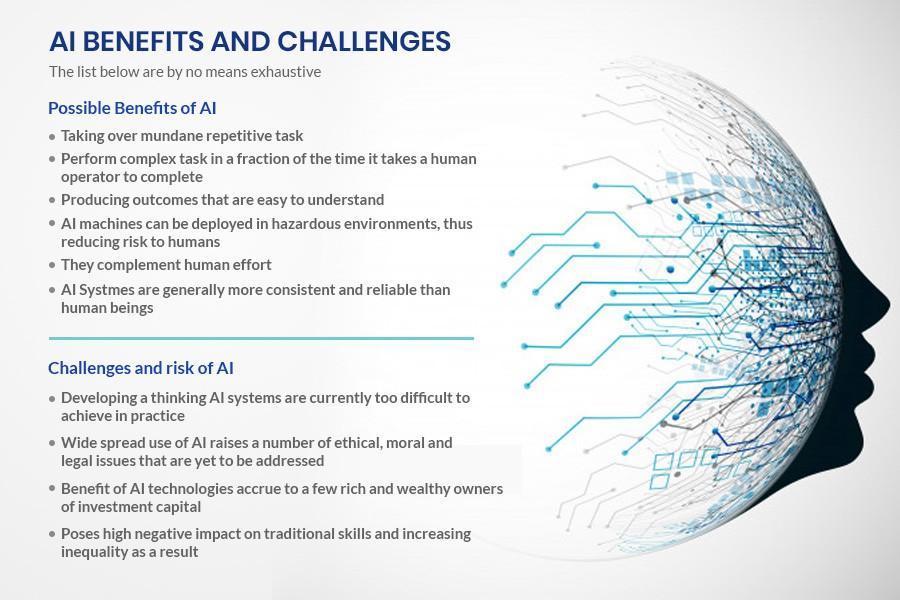
Artificial Intelligence in the Pandemic Era: Benefits & Challenges

AI_Benefits_and_Challenges.jpeg


AI is the main engine of the digital revolution. The COVID-19 crisis has accelerated the need for human-machine digital intelligent platforms facilitating new knowledge, competences and workforce skills, advanced cognitive, scientific, technological, and engineering, social, and emotional skills.

In the AI and Robotics era, there is a high demand for the scientific knowledge, digital competence, and high-technology training in a range of innovative areas of exponential technologies, such as artificial intelligence, machine learning and robotics, data science and big data, cloud and edge computing, the Internet of Thing, 5G, cybersecurity and digital reality.

The combined value – to society and industry – of digital transformation across industries could be greater than $100 trillion over the next 10 years. “Combinatorial” effects of artificial intelligence (AI), machine learning (ML), deep learning (DL), robotics with mobile, cloud, sensors, and analytics among others – are accelerating progress exponentially, but the full potential will not be achieved without the collaboration between humans and machines. 

Artificial Intelligence and machine Learning (ML) form the building block of next generation technology. Their innovative capabilities like computer vision, natural language processing, advanced analytics, enable schools and businesses to create insightful data-driven solutions and contribute to the advancement of the global economy.

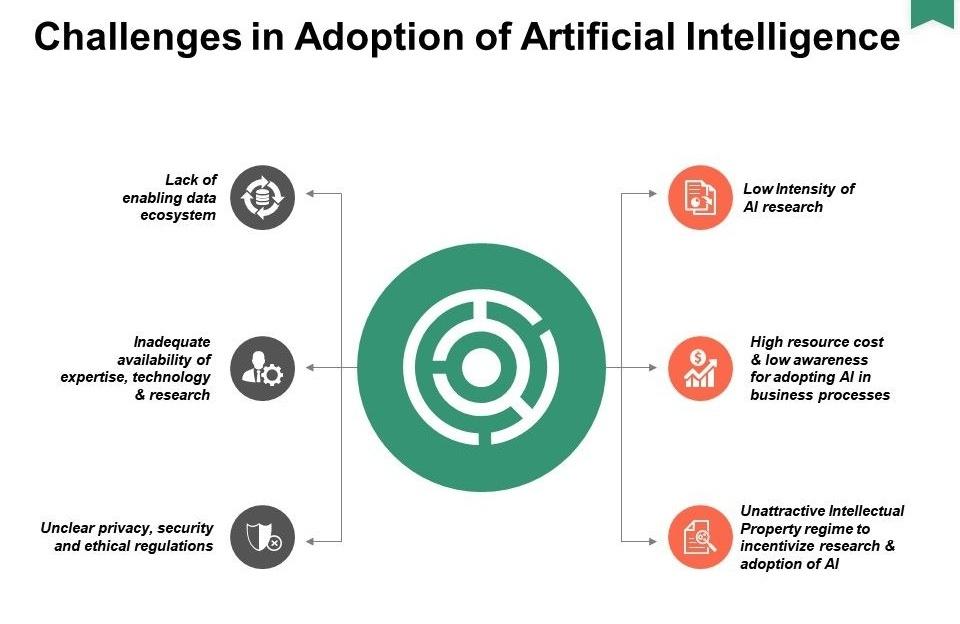
BIGGEST CHALLENGES IN THE ARTIFICIAL INTELLIGENCE INDUSTRY

Challenges_in_AI.jpg

Challenge #1 - Bias of AI Algorithms

AI algorithms can show biased results when written by developers with biased minds. Since there isn’t any transparency about how the decision-making processes run in the background, the real users cannot be sure about its fairness. So, this can result in algorithms that yield biased results. 

Challenge #2 - Lack of Privacy

Most companies love data and they like to keep it. The privacy of citizens is constantly put at risk when companies collect consumer data without taking any prior permission — and this is made easy with the use of AI. Facial recognition algorithms are widely used across the world to support the functionality of different applications and products. Such products are collecting and selling huge amounts of customer data without consent.

Challenge #3 - No Transparency

Artificial Intelligence involves complex programming of products that cannot be explained to the common people. Moreover, algorithms of most of the AI-based products or applications are kept secret to avoid security breaches and similar threats. Due to these reasons, there is no transparency about the internal algorithms of AI products —making it difficult for customers to trust such products.

Challenge #4 - Poor Governance & Accountability

When an AI system or product does something unethical, it’s challenging to assign blame or accountability. Earlier governance functions had to deal with static processes, but AI and data processes are iterative. Thus we need a governance process that can similarly adapt and change.

Challenge #5 - The Curse of Data Annotation

A major chunk of artificial intelligence is based on the fact that tech companies train their computers using labeled data. Data Annotation/labeling requires a large human force and big tech giants like Google/Facebook hire a massive workforce who spend hours labeling the data. The irony here is that tech companies are trying to make smarter systems but they require substantial manual labor.

Challenge #6 - Massive Training Datasets

The current AI-based applications not only require labeled data but also massive data. If you think about the biggest players in AI, which are, Amazon, Google, Facebook, etc they are leading because they have access to so much data. Not all companies have access to massive data. 

Challenge #7 - Quality of Data

There are many aspects to data quality, including consistency, integrity, accuracy, and completeness. Modern systems need to become aware of the quality of data I/O. They must instantly identify potential issues and avoid exposing dirty, inaccurate, or incomplete data to connected production components/ clients. This implies that, even if there is a sudden problematic situation resulting in poor-data quality entries, the system will be able to handle the quality issue and proactively notify the right users. Depending on how critical the issues are, it might also deny serving data to its clients — or serve data while raising the alert/ flagging the potential issues.

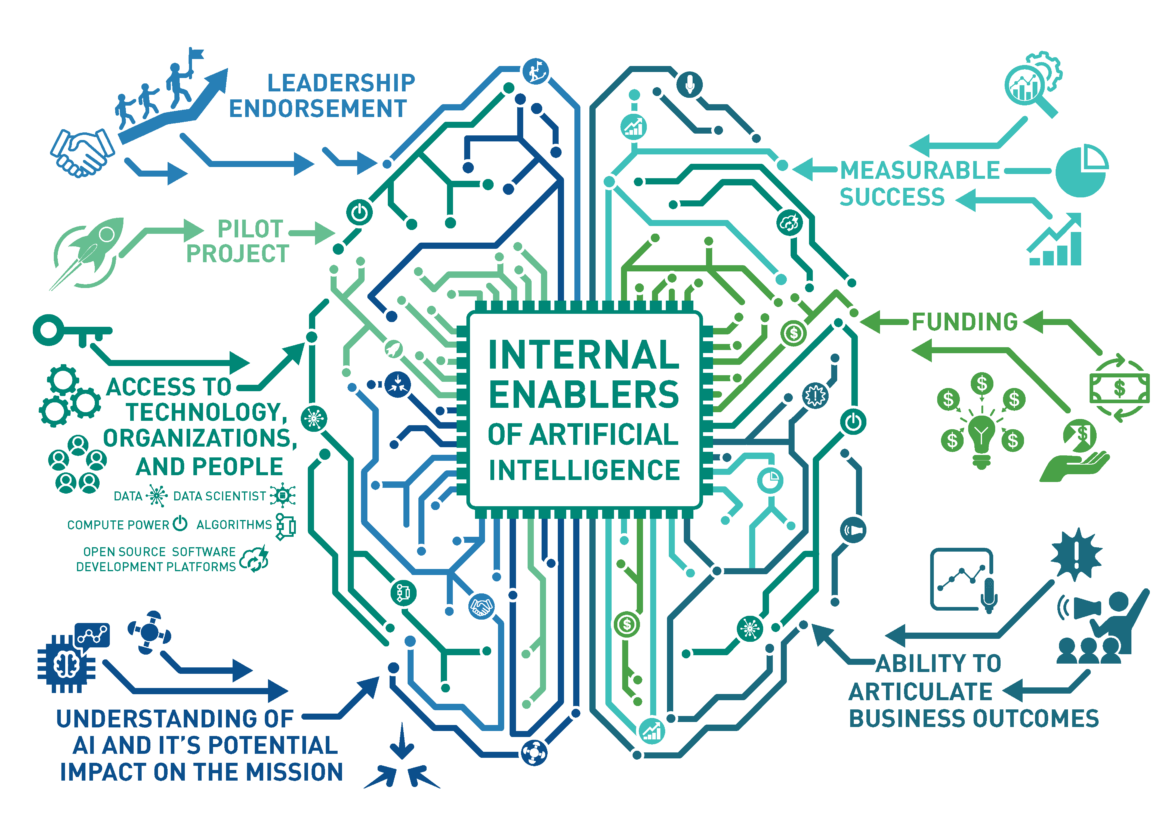
HOW TO SOLVE ARTIFICIAL INTELLIGENCE ISSUES

Internal_Enablers_of_AI.png


Reengineering: There is a great opportunity to redesign business processes and tasks around AI.

Organization and Culture—AI is the child of big data and analytics, and is likely to be subject to the same organization and culture issues as the parent.

Transparency - Companies should focus on increasing AI transparency by tackling poor quality and unlabeled data.

Investment—One key driver to improve artificial intelligence challenges is to invest in research & development. Few companies are demanding ROI analysis both before and after implementation.

CONCLUSION

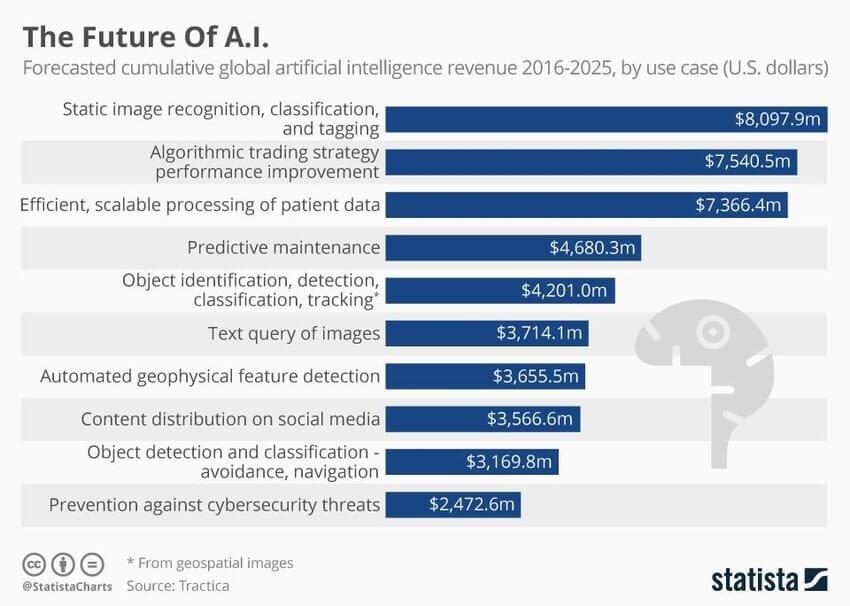
The_Future_of_AI_2016-2025.jpeg


© Statista

In order to ensure appropriate utilization of artificial intelligence, companies need to embrace techniques that help them achieve fairness, security, and explainability. Responsible implementation of AI must reflect the ethics and values of an organization, thus, building trust among its customers, employees, and other stakeholders. 

There is no doubt that the benefits and challenges of advanced technologies like AI are endless, but in seeking these new opportunities, we risk compromising the privacy and integrity of our society and its members. No matter what you may have heard, AI isn't going to solve all your problems. If you want to get the most out of AI, it's important to have the right expectations to avoid setting your team up for disappointment.

TOP 20 B.TECH IN ARTIFICIAL INTELLIGENCE INSTITUTES IN INDIA

The educational institutes and colleges of India are held accounted for creating best talents for technology industry of the country. In the era of digital transformation, where every industry is in demand of skilled Artificial Intelligence (AI) talents, these institutes provide with some great catering of knowledge to harness tech-future of the country. Below are Top 20 Institutes of India Offering B Tech (Bachelors in Technology) Program with Core Specialisation in Artificial Intelligence.


1. Indian Institute Technology

Location: Hyderabad

Description: IIT Hyderabad was the first Indian institute to introduce B. Tech in AI. The Department of AI seeks enthusiastic aspirants of AI for B. Tech Program who can in future contribute to industry demands for better skills and talent. The B.Tech. programme in AI will has an intake of around 20 students per year.

Intake Through: IIT-JEE Advanced

Fees: INR 1.15 lakh for full course


2. Chandigarh University

Location: Chandigarh

Description: Artificial Intelligence at Chandigarh University presents a solid foundation in the principles and technologies that underlie many facets of AI, including logic, knowledge representation, probabilistic models, and machine learning. It teaches you to examine logic and reasoning methods from a computational perspective, learn about agent, search, probabilistic models, perception and cognition, and machine learning and learn about state-of-the-art technologies like Deep Learning, Human Computer Interaction and Augmented Reality

Intake Through: University Entrance Exam

Eligibility: 10+2 with Physics & Mathematics as compulsory subjects along with any two of the following subjects: Chemistry / Biotechnology / Computer Science / Biology with at least 50% marks (45% in case of candidates belonging to SC/ST category) in the aggregate.

Fees: INR 80,000 per semester


3. Indraprastha Institute of Information Technology

Location: Delhi

Description: At IIIT, Students will not only learn about AI but also explore applied domains such as computer vision, natural language processing, robotics, and autonomous systems as well as other interdisciplinary areas such as neuroscience, edge computing, and Internet of Things.

Intake Through: JEE, JAC and Direct Admission Test

Eligibility: 80 percent marks in aggregate for five subjects (including Physics, Chemistry and Math) and 80% in Mathematics in class XII from CBSE Board or equivalent. JEE Mains (of 2019) NTA Score

Fees: INR 1.8 lakh per semester


4. Great Lakes International University

Location: Sri City (Andhra Pradesh)

Description: Bachelor of Technology (B. Tech) in Artificial Intelligence and Machine Learning is a four-year full-time undergraduate program offered by the Great Lakes International University, Sri City.

Intake Through: Admissions are on done on the basis of GLUE test and SAT Score > 1200 or Qualify JEE Mains

Eligibility: The candidate should have passed in (10+2) in 70% marks from CBSE/State Board/ISCE.

Fees: INR 14.22 Lakhs for full course


5. SRM Institute of Science and Technology (SRM IST)

Location: Chennai

Description: SRM Institute of Science and Technology offers B Tech. in Computer Science and Engineering (Artificial Intelligence and Machine Learning).

Intake Through: Admission is through University level counselling based on the rank obtained in SRMJEE (UG). Candidate qualified in JEE Main will be admitted directly even if the candidate doesn’t take SRMJEEE. International students can apply directly to the college.

Eligibility: 50% Mandatory

Subjects: Physics, Chemistry, Mathematics. Candidate must have secured mentioned percentage in the mandatory subjects.

Fees: INR 10.10 lakh for full course


6. Vellore Institute of Technology

Location: Bhopal

Description: Vellore Institute of Technology offers B Tech in Computer Science & Engineering with specialization in Artificial Intelligence & Machine Learning.

Intake Through: Scores of VITEEE 2019 followed by counselling

Eligibility: Candidates appearing for VITEEE in 2019 should have secured an aggregate of 60% in Physics, Chemistry, and Mathematics in the qualifying examination (+2/Intermediate). The average marks obtained in the subjects Physics, Chemistry and Mathematics (PCM) in +2 (or its equivalent) put together should be 50% for candidates belonging to SC/ST & North-Eastern States

Fees: INR 7.92 lakh for full course


7. DY Patil International University

Location: Pune

Description: DY Patil International University offers B Tech in Computer Science and Engineering (Robotics and AI) program.

Intake Through: Admission in B Tech is done through JEE Main

Eligibility:  Passed 10+2 with Physics and Mathematics as compulsory subject along with one of the Chemistry/Biotechnology/ Biology / Technical Vocational Subject. Obtained at least 45% marks (40% in case of candidates belonging to the reserved category) in the above subjects taken together. Passed Diploma (in Engineering and Technology) examination with at least 45% marks (40% in case of candidates belonging to reserved category)

Fees: INR 2.1 Lakh per year


8. University of Petroleum and Energy Studies

Location: Dehradun

Description: The University of Petroleum and Energy Studies offers B. Tech in Computer Science and Engineering (Hons.) in Artificial Intelligence and Machine Learning.

Intake Through: UPESEAT (UPES Engineering Aptitude Test) or Cut off: 60 percentile score JEE Main

Eligibility: Minimum 60% marks at higher & Senior Secondary level (10th & 12th) and minimum 60% aggregate in PCM at senior secondary level (12th class) (With JEE Score)

Or, Minimum 80% marks at higher & Senior Secondary level (10th & 12th) and minimum 80% aggregate in PCM at senior secondary level (12th class)

Fees: INR 12-13 lakh for full course


9. Jain University

Location: Bangalore

Description: B. Tech Computer Science and Technology with specialization in Artificial Intelligence (AI) degree program at Jain University has seen an exponential growth in the last few years. Artificial Intelligence is a well-established exciting specialization of computer science concerned with methods to make computers or machines intelligent.

Intake Through: Direct Admission

Eligibility: Pass in PUC / 10+2 examination with Physics and Mathematics as compulsory subjects along with Chemistry / Computer Science / Electronics as one of the subjects and obtained at least 60% marks (55% in case of SC/ST category) in the above subjects taken together.

Fees: INR 6.40 lakh for full course


10. GH Raisoni College

Location: Nagpur

Description: Preeti Bajaj, the director of GHRCE stated – “In the past two years, Indian companies are investing high on using AI. This has led to a huge requirement of a workforce of AI professionals in India. AI professionals are getting 60-80% hikes while switching jobs, compared with an average of 20-30% in other skill areas. Starting such programme is a step towards meeting the high demand for AI professionals in the technology sector.”

The college will begin the B Tech in Artificial Intelligence courses with an intake of 60 students which quite higher than that of IIT H. The institute has been ranked 11th pan India in the engineering discipline in the NIRF 2019 Ranking and also ranked in the top 100 for ARIIA (i.e. Atal Ranking of Institutions on Innovation Achievements) Ranking 2019.

Fees: INR 1.6 lakh per year


11. Sri Ramaswamy Memorial Institute of Science and Technology (SRM) University

Location: Sonipat

Description: Sri Ramaswamy Memorial Institute of Science and Technology (SRM) University offers CSE with specialisation in Artificial Intelligence and Machine Learning.

Intake Through: Direct Admission (University Test)

Eligibility: For B Tech, a candidate must have passed 10+2 examination with PCM as the main subject and minimum aggregate of 50% marks. Candidates with a valid SRMJEEE/ SRMHCAT/ NEET/ IPU CET/ JEE Main score are eligible to apply for admission to the B Tech program.

Fees: INR6.50 lakh for full course


12. Sharda University

Location: Greater Noida

Description: B. Tech in Computer Science (Artificial Learning and Machine Learning) is an undergraduate programme with advanced learning solutions imparting knowledge of advanced innovations like machine learning, often called deep learning and artificial intelligence.

Intake Through: SUAT (Online Test) Followed by Personal Interview/ JEE All India Rank upto 3 Lakh/ UPSEE All India Rank upto 50 000

Eligibility: Matriculation with-60% marks Sr. Secondary (10+2) 70% marks (Aggregate) & minimum 60% marks in PCM Computer Science/PCB for Biotechnology without gap between 10th and 12th. Minimum 50% marks in Maths

Fees: INR 1.8 lakh per year


13. Quantum University

Location: Dehradun

Description: Quantum University of Dehradun offers B. Tech (Hons.) in Computer Science & Engineering with specialization in AI & Machine Learning in collaboration with Xebia.

Intake Through: B Tech – Q-Care/JEE (Main) 2019

Eligibility: 10+2 with Physics and Mathematics as compulsory subjects and Computer Science (IT) /Biology/Biotechnology/Chemistry as one of the subjects with minimum 55% marks

Fees: INR 5.70 lakh for full course


14. Sage University

Location: Indore

Description: B. Tech in Artificial Intelligence (AI) degree Program has seen an exponential growth in the last few years. It is fuelled by the explosion in the use of Internet, extensive penetration of smartphones, increasing use of online services, social media, e-banking and increasing incidents on Human workload.

Intake Through:

•  Admissions to the B Tech Programme would be made on the basis of Joint Entrance Examination JEE.

•  Direct admission for XII Std Board Toppers.

•  Merit Based Counselling will be held on the basis of JEE (Mains); All India Rank (AIR)followed by 12th Std percentage in PCME / PMBE / PME Comp.

•  Direct Admission to NRI / Industry Sponsored candidates.

Eligibility: Minimum 60% marks in X Std & aggregate 60% marks in XII Std and minimum 60% in Physics Chemistry Maths English/Physics Maths Bio English/Physics Maths English Computer.

Fees: INR 1.25 lakh per year


15. SVVV – Shri Vaishnav Vidyapeeth Vishwavidyalaya

Location: Indore

Description: Shri Vaishnav Vidyapeeth Vishwavidyalaya (SVV) offers B Tech in Computer Science and Engineering with specialisation in Artificial Intelligence.

Intake Through: JEE Main, SVET

Eligibility: 45% in 12th is minimum eligibility to apply. Mandatory Subjects: Physics, Mathematics, Chemistry/BioTech. Vocational. Candidate must have secured mentioned percentage in mandatory subjects. Students awaiting results can also apply on provisional basis. Mentioned percentage for SC, ST, OBC (excluding creamy layer) category is for students belonging to Madhya Pradesh.

Fees: INR 91,000 per year


16. Dehradun Institute of Technology (DIT) University

Location: Dehradun

Description: Dehradun Institute of Technology offers B. Tech. Computer Science Engineering with specialization in Artificial Intelligence and Data Science degree program.

Intake Through: The admission process will be based on marks secured in JEE-Main Entrance Examination.

Eligibility: For DIT University admissions 2019, the minimum requirement is 10+2 examination with Physics, Chemistry, Mathematics, English / Physics, Mathematics, Biology, English / Physics, Mathematics, English, Computer Science as a mandatory subject with minimum 60% marks.

Fees: INR 10 lakh for full course


17. Lovely Professional University

Location: Phagwara

Description: Lovely Professional University offers B Tech in Computer Science and Engineering with Specialisation in AI.

Intake Through: LPUNEST or JEE Main

Eligibility: Pass with 60% aggregate marks in 10+2 (with Physics, Mathematics and English) or equivalent

Fees: INR 10 Lakh for full course


18. JK Lakshmipat University

Location: Jaipur

Description: The JK Lakshmipat University of Jaipur offers B Tech Computer Science & Engineering (Specialization in Artificial Intelligence in Collaboration With IBM).

Intake Through: The applicants are required to appear in one of the national level engineering admission tests, such as JEE or any other equivalent state level engineering entrance examination held in 2019. In case the candidate has not appeared for any national level engineering tests, they will have to appear in the JKLU Engineering Entrance Test (EET) to qualify for the programme.

Eligibility: Minimum 50% aggregate marks (45% for SC/ST Candidates), with minimum 50% marks or equivalent grades in Physics, Mathematics and any one of the four optional courses (Biology, Biotechnology, Chemistry, Computer Science) from a recognized Central/State Board/University Examination in India or in any foreign country recognized as equivalent to 10+2 system by the Association of Indian Universities (AIU).

Students appearing in the final examination of 10+2 may also apply.

Diploma holders (3-year Polytechnic programme) from a recognized Institute, with minimum 45% marks are eligible for lateral entry into 2nd year of B Tech, in any programme of engineering offered at JKLU.

Fees: INR 1.78, lakh per year


19. Galgotias University

Location: Greater Noida

Description: At Galgotias, students will acquire ability to explain and apply key ideas in artificial intelligence and machine learning and how they are being used in IBM, Google, Amazon, Facebook, etc. Students will get experience in implementing scalable solutions with AI and machine leaning components, technologies and tools.

Eligibility: Minimum 60% marks in PCM in XIIth with minimum 40%ile or upto 5 Lakh rank in JEE Mains, or Min. 60% marks in PCM in class XIIth (for Merit based admission)

Fees: INR 1,70,000 per year


20. CT University

Location: Ludhiana

Description: Artificial Intelligence is the broader concept of machines being able to carry out tasks in a way that we would consider “smart”. And, Machine Learning is a current application of AI based around the idea that we should really just be able to give machines access to data and let them learn for themselves. Therefore, CT University offers B Tech in Computer Science Engineering (specialization in Artificial Intelligence and Machine Learning (AI&ML))

Eligibility: Pass with 50% aggregate marks in 10+2 With English, Physics, Mathematics as compulsory subjects or equivalent along with Chemistry/Biotechnology/Computer Science/Biology as a third science subject from recognized board

Fees: INR 7.56 lakh for full course


Sunday, 3 October 2021

Abductive Inference & future path of #AI

All about Agile, Ansible, DevOps, Docker, EXIN, Git, ICT, Jenkins, Kubernetes, Puppet, Selenium, Python, etc
Myth of Artificial Intelligence

Welcome to AI book reviews, a series of posts that explore the latest literature on artificial intelligence.

Recent advances in deep learning have rekindled interest in the imminence of machines that can think and act like humans, or artificial general intelligence. By following the path of building bigger and better neural networks, the thinking goes, we will be able to get closer and closer to creating a digital version of the human brain.

But this is a myth, argues computer scientist Erik Larson, and all evidence suggests that human and machine intelligence are radically different. Larson’s new book, The Myth of Artificial Intelligence: Why Computers Can’t Think the Way We Do, discusses how widely publicized misconceptions about intelligence and inference have led AI research down narrow paths that are limiting innovation and scientific discoveries.

And unless scientists, researchers, and the organizations that support their work don’t change course, Larson warns, they will be doomed to “resignation to the creep of a machine-land, where genuine invention is sidelined in favor of futuristic talk advocating current approaches, often from entrenched interests.”

The myth of artificial intelligence

myth of AI book cover
The Myth of Artificial Intelligence, by Erik J. Larson

From a scientific standpoint, the myth of AI assumes that we will achieve artificial general intelligence (AGI) by making progress on narrow applications, such as classifying images, understanding voice commands, or playing games. But the technologies underlying these narrow AI systems do not address the broader challenges that must be solved for general intelligence capabilities, such as holding basic conversations, accomplishing simple chores in a house, or other tasks that require common sense.

“As we successfully apply simpler, narrow versions of intelligence that benefit from faster computers and lots of data, we are not making incremental progress, but rather picking the low-hanging fruit,” Larson writes.

The cultural consequence of the myth of AI is ignoring the scientific mystery of intelligence and endlessly talking about ongoing progress on deep learning and other contemporary technologies. This myth discourages scientists from thinking about new ways to tackle the challenge of intelligence.

“We are unlikely to get innovation if we choose to ignore a core mystery rather than face it up,” Larson writes. “A healthy culture for innovation emphasizes exploring unknowns, not hyping extensions of existing methods… Mythology about inevitable success in AI tends to extinguish the very culture of invention necessary for real progress.”

Deductive, inductive, and abductive inference

Flowchart

You step out of your home and notice that the street is wet. Your first thought is that it must have been raining. But it’s sunny and the sidewalk is dry, so you immediately cross out the possibility of rain. As you look to the side, you see a road wash tanker parked down the street. You conclude that the road is wet because the tanker washed it.

This is an example “inference,” the act of going from observations to conclusions, and is the basic function of intelligent beings. We’re constantly inferring things based on what we know and what we perceive. Most of it happens subconsciously, in the background of our mind, without focus and direct attention.

“Any system that infers must have some basic intelligence, because the very act of using what is known and what is observed to update beliefs is inescapably tied up with what we mean by intelligence,” Larson writes.  

AI researchers base their systems on two types of inference machines: deductive and inductive. Deductive inference uses prior knowledge to reason about the world. This is the basis of symbolic artificial intelligence, the main focus of researchers in the early decades of AI. Engineers create symbolic systems by endowing them with a predefined set of rules and facts, and the AI uses this knowledge to reason about the data it receives.

Inductive inference, which has gained more traction among AI researchers and tech companies in the past decade, is the acquisition of knowledge through experience. Machine learning algorithms are inductive inference engines. An ML model trained on relevant examples will find patterns that map inputs to outputs. In recent years, AI researchers have used machine learning, big data, and advanced processors to train models on tasks that were beyond the capacity of symbolic systems.

A third type of reasoning, abductive inference, was first introduced by American scientist Charles Sanders Peirce in the 19th century. Abductive inference is the cognitive ability to come up with intuitions and hypotheses, to make guesses that are better than random stabs at the truth.

Charles Sanders Peirce
American scientist Charles Sanders Peirce proposed abductive inference in the 19th century. Source: New York Public Library, Public Domain

For example, there can be numerous reasons for the street to be wet (including some that we haven’t directly experienced before), but abductive inference enables us to select the most promising hypotheses, quickly eliminate the wrong ones, look for new ones and reach a reliable conclusion. As Larson puts it in The Myth of Artificial Intelligence, “We guess, out of a background of effectively infinite possibilities, which hypotheses seem likely or plausible.”

Abductive inference is what many refer to as “common sense.” It is the conceptual framework within which we view facts or data and the glue that brings the other types of inference together. It enables us to focus at any moment on what’s relevant among the ton of information that exists in our mind and the ton of data we’re receiving through our senses.

The problem is that the AI community hasn’t paid enough attention to abductive inference.

AI and abductive inference

Abduction entered the AI discussion with attempts at Abductive Logic Programming in the 1980s and 1990s, but those efforts were flawed and later abandoned. “They were reformulations of logic programming, which is a variant of deduction,” Larson told TechTalks.

Erik Larson
Erik J. Larson, author of “The Myth of Artificial Intelligence”

Abduction got another chance in the 2010s as Bayesian networks, inference engines that try to compute causality. But like the earlier approaches, the newer approaches shared the flaw of not capturing true abduction, Larson said, adding that Bayesian and other graphical models “are variants of induction.” In The Myth of Artificial Intelligence, he refers to them as “abduction in name only.”

For the most part, the history of AI has been dominated by deduction and induction.

“When the early AI pioneers like [Alan] Newell, [Herbert] Simon, [John] McCarthy, and [Marvin] Minsky took up the question of artificial inference (the core of AI), they assumed that writing deductive-style rules would suffice to generate intelligent thought and action,” Larson said. “That was never the case, really, as should have been earlier acknowledged in discussions about how we do science.”

For decades, researchers tried to expand the powers of symbolic AI systems by providing them with manually written rules and facts. The premise was that if you endow an AI system with all the knowledge that humans know, it will be able to act as smartly as humans. But pure symbolic AI has failed for various reasons. Symbolic systems can’t acquire and add new knowledge, which makes them rigid. Creating symbolic AI becomes an endless chase of adding new facts and rules only to find the system making new mistakes that it can’t fix. And much of our knowledge is implicit and cannot be expressed in rules and facts and fed to symbolic systems.

“It’s curious here that no one really explicitly stopped and said ‘Wait. This is not going to work!’” Larson said. “That would have shifted research directly towards abduction or hypothesis generation or, say, ‘context-sensitive inference.’”

In the past two decades, with the growing availability of data and compute resources, machine learning algorithms—especially deep neural networks—have become the focus of attention in the AI community. Deep learning technology has unlocked many applications that were previously beyond the limits of computers. And it has attracted interest and money from some of the wealthiest companies in the world.

“I think with the advent of the World Wide Web, the empirical or inductive (data-centric) approaches took over, and abduction, as with deduction, was largely forgotten,” Larson said.

But machine learning systems also suffer from severe limits, including the lack of causality, poor handling of edge cases, and the need for too much data. And these limits are becoming more evident and problematic as researchers try to apply ML to sensitive fields such as healthcare and finance.

Abductive inference and future paths of AI

machine learning causality

Some scientists, including reinforcement learning pioneer Richard Sutton, believe that we should stick to methods that can scale with the availability of data and computation, namely learning and search. For example, as neural networks grow bigger and are trained on more data, they will eventually overcome their limits and lead to new breakthroughs.

Larson dismisses the scaling up of data-driven AI as “fundamentally flawed as a model for intelligence.” While both search and learning can provide useful applications, they are based on non-abductive inference, he reiterates.

“Search won’t scale into commonsense or abductive inference without a revolution in thinking about inference, which hasn’t happened yet. Similarly with machine learning, the data-driven nature of learning approaches means essentially that the inferences have to be in the data, so to speak, and that’s demonstrably not true of many intelligent inferences that people routinely perform,” Larson said. “We don’t just look to the past, captured, say, in a large dataset, to figure out what to conclude or think or infer about the future.”

Other scientists believe that hybrid AI that brings together symbolic systems and neural networks will have a bigger promise of dealing with the shortcomings of deep learning. One example is IBM Watson, which became famous when it beat world champions at Jeopardy! More recent proof-of-concept hybrid models have shown promising results in applications where symbolic AI and deep learning alone perform poorly.

Larson believes that hybrid systems can fill in the gaps in machine learning–only or rules-based–only approaches. As a researcher in the field of natural language processing, he is currently working on combining large pre-trained language models like GPT-3 with older work on the semantic web in the form of knowledge graphs to create better applications in search, question answering, and other tasks.

“But deduction-induction combos don’t get us to abduction, because the three types of inference are formally distinct, so they don’t reduce to each other and can’t be combined to get a third,” he said.

In The Myth of Artificial Intelligence, Larson describes attempts to circumvent abduction as the “inference trap.”

“Purely inductively inspired techniques like machine learning remain inadequate, no matter how fast computers get, and hybrid systems like Watson fall short of general understanding as well,” he writes. “In open-ended scenarios requiring knowledge about the world like language understanding, abduction is central and irreplaceable. Because of this, attempts at combining deductive and inductive strategies are always doomed to fail… The field needs a fundamental theory of abduction. In the meantime, we are stuck in traps.”

The commercialization of AI

tech giants artificial intelligence

The AI community’s narrow focus on data-driven approaches has centralized research and innovation in a few organizations that have vast stores of data and deep pockets. With deep learning becoming a useful way to turn data into profitable products, big tech companies are now locked in a tight race to hire AI talent, driving researchers away from academia by offering them lucrative salaries.

This shift has made it very difficult for non-profit labs and small companies to become involved in AI research.

“When you tie research and development in AI to the ownership and control of very large datasets, you get a barrier to entry for start-ups, who don’t own the data,” Larson said, adding that data-driven AI intrinsically creates “winner-take-all” scenarios in the commercial sector.

The monopolization of AI is in turn hampering scientific research. With big tech companies focusing on creating applications in which they can leverage their vast data resources to maintain the edge over their competitors, there’s little incentive to explore alternative approaches to AI. Work in the field starts to skew toward narrow and profitable applications at the expense of efforts that can lead to new inventions.

“No one at present knows how AI would look in the absence of such gargantuan centralized datasets, so there’s nothing really on offer for entrepreneurs looking to compete by designing different and more powerful AI,” Larson said.

In his book, Larson warns about the current culture of AI, which “is squeezing profits out of low-hanging fruit, while continuing to spin AI mythology.” The illusion of progress on artificial general intelligence can lead to another AI winter, he writes.

But while an AI winter might dampen interest in deep learning and data-driven AI, it can open the way for a new generation of thinkers to explore new pathways. Larson hopes scientists start looking beyond existing methods.

In The Myth of Artificial Intelligence, Larson provides an inference framework that sheds light on the challenges that the field faces today and helps readers to see through the overblown claims about progress toward AGI or singularity.

“My hope is that non-specialists have some tools to combat this kind of inevitability thinking, which isn’t scientific, and that my colleagues and other AI scientists can view it as a wake-up call to get to work on the very real problems the field faces,” Larson said.

Abductive Inference & future path of #AI ▶️
#Analytics, #MachineLearning, #AI, #Python, #Rstats, #Reactjs, #IoT, #IIoT, #ML, #NLP, #Linux, #flutter, #Serverless, #javascript, #SDGs, #TensorFlow, #SelfDrivingCars,
#CloudComputing, #BigData, #Robotics, #Cloud, #100DaysOfCode,

Rank

seo