-->

Welcome to our Coding with python Page!!! hier you find various code with PHP, Python, AI, Cyber, etc ... Electricity, Energy, Nuclear Power

Showing posts with label Machine Learning. Show all posts

Tuesday, 2 May 2023

Tutorial Step by step machine learning based land use classification using Python

Basic steps to perform machine learning based land use classification using Python:

  1. Data preparation: Gather data on land use from various sources such as satellite imagery, ground survey, or government data. Process the data to make sure it is in a format that can be easily used by machine learning algorithms.

  2. Feature extraction: Extract features from the data such as vegetation index, texture, or color information. This can be done using various Python libraries such as scikit-image or OpenCV.

  3. Data labeling: Label the data with the correct land use category. This can be done using various techniques such as supervised learning, semi-supervised learning, or unsupervised learning.

  4. Model training: Train the machine learning model using the labeled data. You can use various algorithms such as Decision Trees, Random Forest, or Support Vector Machines (SVM) to train your model.

  5. Model evaluation: Evaluate the performance of your model using metrics such as accuracy, precision, recall, and F1 score.

  6. Model deployment: Once you are satisfied with the performance of your model, you can deploy it for land use classification.

Here are some tutorials and resources that can help you with machine learning based land use classification using Python:

  1. Land Use Classification with Machine Learning - This tutorial provides a step-by-step guide to performing land use classification using machine learning in Python. It covers data preparation, feature extraction, model training, and evaluation. The tutorial also includes code examples and print screens to help you follow along.

  2. Machine Learning for Land Use and Land Cover Classification - This resource provides an overview of machine learning techniques for land use and land cover classification. It covers various algorithms and techniques such as SVM, Decision Trees, Random Forest, and Deep Learning. The resource also includes code examples and print screens to help you understand the concepts.

  3. Machine Learning with Python - This book provides an introduction to machine learning using Python. It covers various topics such as data preprocessing, feature extraction, model training, and evaluation. The book also includes code examples and print screens to help you understand the concepts.

I hope this helps you get started with machine learning based land use classification using Python. Good luck!


Here is a step-by-step guide on Machine Learning based Land Use Classification with Python using scikit-learn and TensorFlow libraries.

Step 1: Data Acquisition The first step in any machine learning project is acquiring the data. For land use classification, you can obtain satellite imagery data from public sources such as the US Geological Survey (USGS) or the European Space Agency (ESA). For this tutorial, we will use the Sentinel-2 satellite imagery data provided by ESA.

Step 2: Data Preprocessing Once you have obtained the satellite imagery data, you will need to preprocess it before using it for classification. The preprocessing steps include:

  1. Loading the data into a format that can be read by Python.
  2. Removing any clouds or atmospheric noise from the images.
  3. Resampling the data to a common resolution.
  4. Splitting the data into training and testing sets.

Here's an example of how to load and preprocess the data:

python
import rasterio import numpy as np from sklearn.model_selection import train_test_split from sklearn.preprocessing import StandardScaler # Load the image and mask data with rasterio.open('image.tif') as src: image_data = src.read() with rasterio.open('mask.tif') as src: mask_data = src.read() # Remove clouds and atmospheric noise # ... # Resample the data # ... # Flatten the data into a 2D array image_data = np.transpose(image_data, (1, 2, 0)) mask_data = np.transpose(mask_data, (1, 2, 0)) rows, cols, bands = image_data.shape image_data = np.reshape(image_data, (rows * cols, bands)) mask_data = np.reshape(mask_data, (rows * cols,)) # Split the data into training and testing sets X_train, X_test, y_train, y_test = train_test_split(image_data, mask_data, test_size=0.2, random_state=42) # Standardize the data scaler = StandardScaler() X_train = scaler.fit_transform(X_train) X_test = scaler.transform(X_test)

Step 3: Feature Extraction In machine learning, the process of converting raw input data into a set of meaningful features is known as feature extraction. Feature extraction can be performed manually, or by using automated techniques such as principal component analysis (PCA) or independent component analysis (ICA).

Here's an example of how to perform feature extraction using PCA:

python
from sklearn.decomposition import PCA # Perform PCA on the training data pca = PCA(n_components=10) X_train_pca = pca.fit_transform(X_train) # Apply the same transformation to the test data X_test_pca = pca.transform(X_test)

Step 4: Training the Model Once the data has been preprocessed and feature extraction has been performed, the next step is to train the machine learning model. For land use classification, we will use the scikit-learn library to train a Random Forest Classifier.

python
from sklearn.ensemble import RandomForestClassifier # Train the random forest classifier clf = RandomForestClassifier(n_estimators=100, random_state=42) clf.fit(X_train_pca, y_train)

Step 5: Evaluating the Model Once the model has been trained, the next step is to evaluate its performance on the testing set. We will use the confusion matrix and classification report to evaluate the model's performance.

python
from sklearn.metrics import confusion_matrix, classification_report # Evaluate the model on the testing set y_pred = clf.predict(X_test_pca) print(confusion_matrix(y_test, y_pred)) print(classification_report(y_test, y

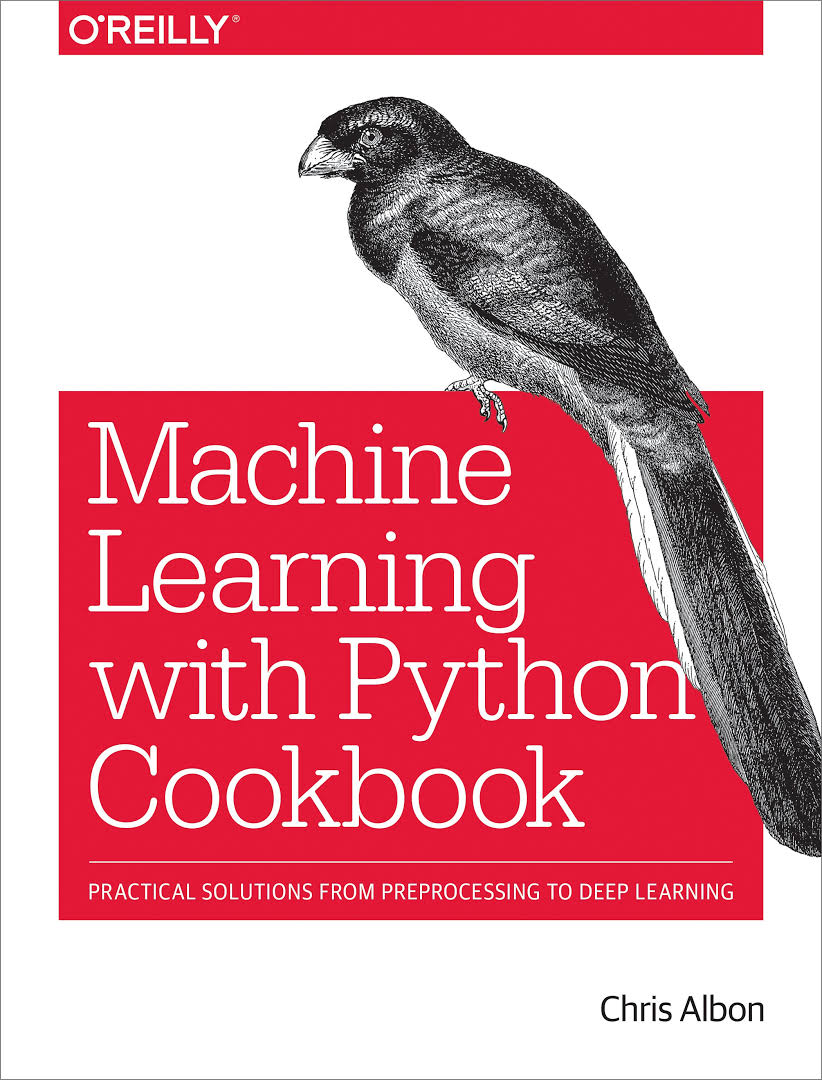
Free Machine Learning with Python cookbooks (PDF)

There are several great Machine Learning with Python cookbooks available, each with its own strengths and focuses. Here are a few popular ones:

Python Machine Learning Cookbook


This cookbook covers a wide range of topics in machine learning, from data cleaning and preparation to model selection and evaluation. It includes practical examples and code snippets to help readers apply the concepts covered in the book.

  • "Applied Machine Learning" by Kelleher and Tierney: 

This book takes a practical approach to machine learning, covering topics such as data preparation, feature engineering, and model selection. It includes code examples in Python and R and provides guidance on how to apply machine learning techniques to real-world problems.


This popular book covers a broad range of topics in machine learning, including classification, regression, clustering, and deep learning. It includes practical examples and code snippets using popular Python libraries such as scikit-learn, Keras, and TensorFlow.


This book covers a wide range of topics in machine learning, including data preprocessing, classification, regression, clustering, and deep learning. It includes code examples in Python and provides guidance on how to implement machine learning algorithms from scratch.

Ultimately, the best Machine Learning with Python cookbook for you will depend on your background, interests, and learning goals. I recommend reviewing the table of contents and sample chapters of each book to determine which one best aligns with your needs.

Monday, 1 May 2023

The history of the Artificial Intelligence

Introduction:

Artificial Intelligence (AI) is an interdisciplinary field that involves the development of intelligent agents that can perform tasks that typically require human intelligence. The history of AI dates back to ancient times, where people tried to create intelligent machines. In this report, we will take a journey through the history of AI, highlighting the significant breakthroughs and milestones in the development of AI.

The history of the Artificial Intelligence


The Beginnings of AI:

The origins of AI can be traced back to ancient times, where Greek myths talked about mechanical men that could think and act like humans. The first recorded example of a machine that could reason was created by the mathematician and philosopher Ramon Lull in the 13th century. Lull's machine used a series of rotating discs with symbols to generate combinations of concepts, which could be used to answer questions or solve problems.

The Modern Era:

The modern era of AI began in the mid-20th century, with the development of electronic computers. In 1943, Warren McCulloch and Walter Pitts introduced the first model of an artificial neural network, which was inspired by the workings of the human brain. In 1950, Alan Turing proposed the "Turing Test," which evaluates a machine's ability to exhibit intelligent behavior that is indistinguishable from that of a human.

In the late 1950s and early 1960s, researchers began to develop systems that could reason and learn from experience. One of the earliest examples of this was the General Problem Solver (GPS), developed by Herbert Simon and Allen Newell. GPS could solve a wide range of problems by representing them as a set of rules.

The AI Winter:

Despite these early breakthroughs, progress in AI was slow, and by the 1970s, many researchers had become disillusioned with the field. This period is known as the "AI Winter," as funding for AI research dried up, and many researchers left the field. However, a small group of researchers continued to work on AI, and in the 1980s, progress began to accelerate.

Expert Systems:

One of the breakthroughs of the 1980s was the development of expert systems, which are computer programs that can mimic the decision-making abilities of a human expert in a particular domain. Expert systems were used in a variety of applications, such as medical diagnosis, financial analysis, and engineering design.

Machine Learning:

Another breakthrough of the 1980s was the development of machine learning algorithms, which enabled computers to learn from data. The most famous of these algorithms is the backpropagation algorithm, which is used to train artificial neural networks. With machine learning, computers could begin to perform tasks that were previously thought to be too complex for machines.

The Rise of Big Data and Deep Learning:

The 21st century has seen explosive growth in the amount of data available, which has led to the development of new AI techniques, such as deep learning. Deep learning is a type of machine learning that uses neural networks with many layers to extract features from data. Deep learning has been used in a variety of applications, such as speech recognition, image recognition, and natural language processing.

Conclusion:

In conclusion, the history of AI has been characterized by breakthroughs and setbacks, but progress has been steady. The field of AI has come a long way since its beginnings in ancient Greece, and the development of electronic computers has led to significant breakthroughs in the mid-20th century. Despite the setbacks of the AI Winter, the field has continued to advance, and recent breakthroughs in deep learning have the potential to revolutionize many fields.

Rank

seo