-->

Welcome to our Coding with python Page!!! hier you find various code with PHP, Python, AI, Cyber, etc ... Electricity, Energy, Nuclear Power

Showing posts with label Robotics. Show all posts

Wednesday, 13 October 2021

WHAT ARE THE BIGGEST CHALLENGES IN ARTIFICIAL INTELLIGENCE AND HOW TO SOLVE THEM?

Artificial intelligence (AI) is set to change how the world works. Although it's not perfect, artificial intelligence is a gamer changer. 

Artificial Intelligence in the Pandemic Era: Benefits & Challenges
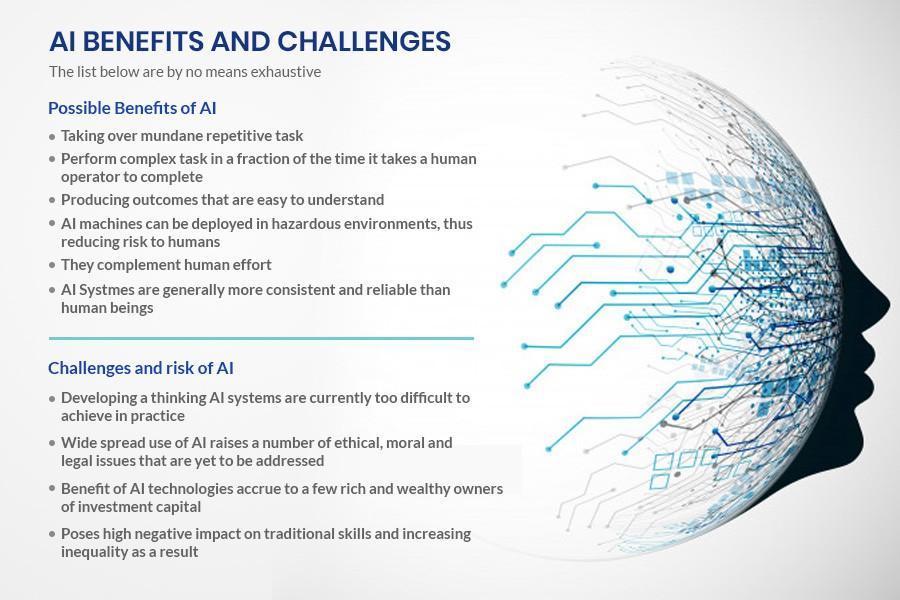
AI_Benefits_and_Challenges.jpeg


AI is the main engine of the digital revolution. The COVID-19 crisis has accelerated the need for human-machine digital intelligent platforms facilitating new knowledge, competences and workforce skills, advanced cognitive, scientific, technological, and engineering, social, and emotional skills.

In the AI and Robotics era, there is a high demand for the scientific knowledge, digital competence, and high-technology training in a range of innovative areas of exponential technologies, such as artificial intelligence, machine learning and robotics, data science and big data, cloud and edge computing, the Internet of Thing, 5G, cybersecurity and digital reality.

The combined value – to society and industry – of digital transformation across industries could be greater than $100 trillion over the next 10 years. “Combinatorial” effects of artificial intelligence (AI), machine learning (ML), deep learning (DL), robotics with mobile, cloud, sensors, and analytics among others – are accelerating progress exponentially, but the full potential will not be achieved without the collaboration between humans and machines. 

Artificial Intelligence and machine Learning (ML) form the building block of next generation technology. Their innovative capabilities like computer vision, natural language processing, advanced analytics, enable schools and businesses to create insightful data-driven solutions and contribute to the advancement of the global economy.

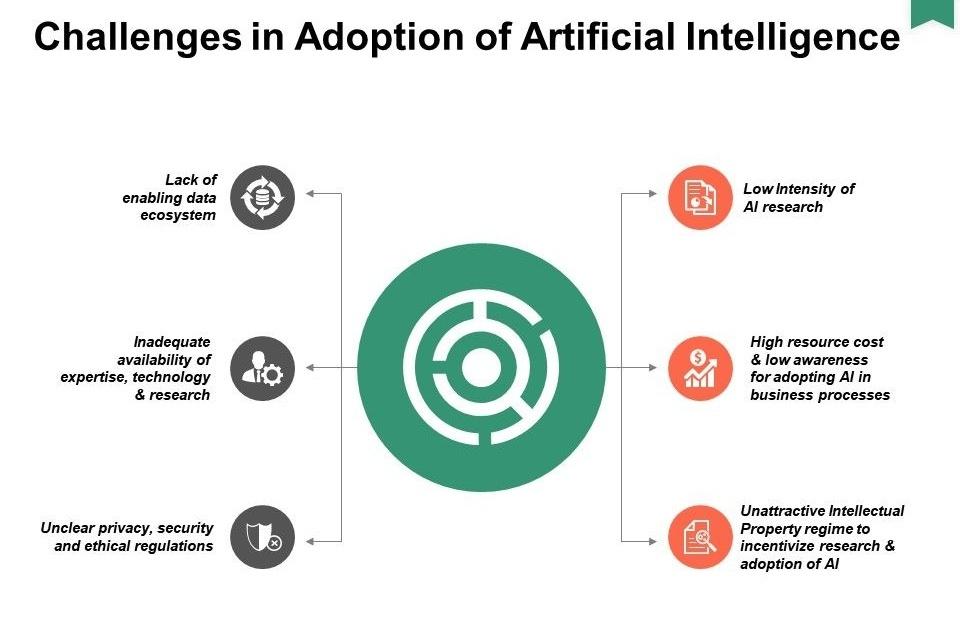
BIGGEST CHALLENGES IN THE ARTIFICIAL INTELLIGENCE INDUSTRY
Challenges_in_AI.jpg

Challenge #1 - Bias of AI Algorithms

AI algorithms can show biased results when written by developers with biased minds. Since there isn’t any transparency about how the decision-making processes run in the background, the real users cannot be sure about its fairness. So, this can result in algorithms that yield biased results. 

Challenge #2 - Lack of Privacy

Most companies love data and they like to keep it. The privacy of citizens is constantly put at risk when companies collect consumer data without taking any prior permission — and this is made easy with the use of AI. Facial recognition algorithms are widely used across the world to support the functionality of different applications and products. Such products are collecting and selling huge amounts of customer data without consent.

Challenge #3 - No Transparency

Artificial Intelligence involves complex programming of products that cannot be explained to the common people. Moreover, algorithms of most of the AI-based products or applications are kept secret to avoid security breaches and similar threats. Due to these reasons, there is no transparency about the internal algorithms of AI products —making it difficult for customers to trust such products.

Challenge #4 - Poor Governance & Accountability

When an AI system or product does something unethical, it’s challenging to assign blame or accountability. Earlier governance functions had to deal with static processes, but AI and data processes are iterative. Thus we need a governance process that can similarly adapt and change.

Challenge #5 - The Curse of Data Annotation

A major chunk of artificial intelligence is based on the fact that tech companies train their computers using labeled data. Data Annotation/labeling requires a large human force and big tech giants like Google/Facebook hire a massive workforce who spend hours labeling the data. The irony here is that tech companies are trying to make smarter systems but they require substantial manual labor.

Challenge #6 - Massive Training Datasets

The current AI-based applications not only require labeled data but also massive data. If you think about the biggest players in AI, which are, Amazon, Google, Facebook, etc they are leading because they have access to so much data. Not all companies have access to massive data. 

Challenge #7 - Quality of Data

There are many aspects to data quality, including consistency, integrity, accuracy, and completeness. Modern systems need to become aware of the quality of data I/O. They must instantly identify potential issues and avoid exposing dirty, inaccurate, or incomplete data to connected production components/ clients. This implies that, even if there is a sudden problematic situation resulting in poor-data quality entries, the system will be able to handle the quality issue and proactively notify the right users. Depending on how critical the issues are, it might also deny serving data to its clients — or serve data while raising the alert/ flagging the potential issues.

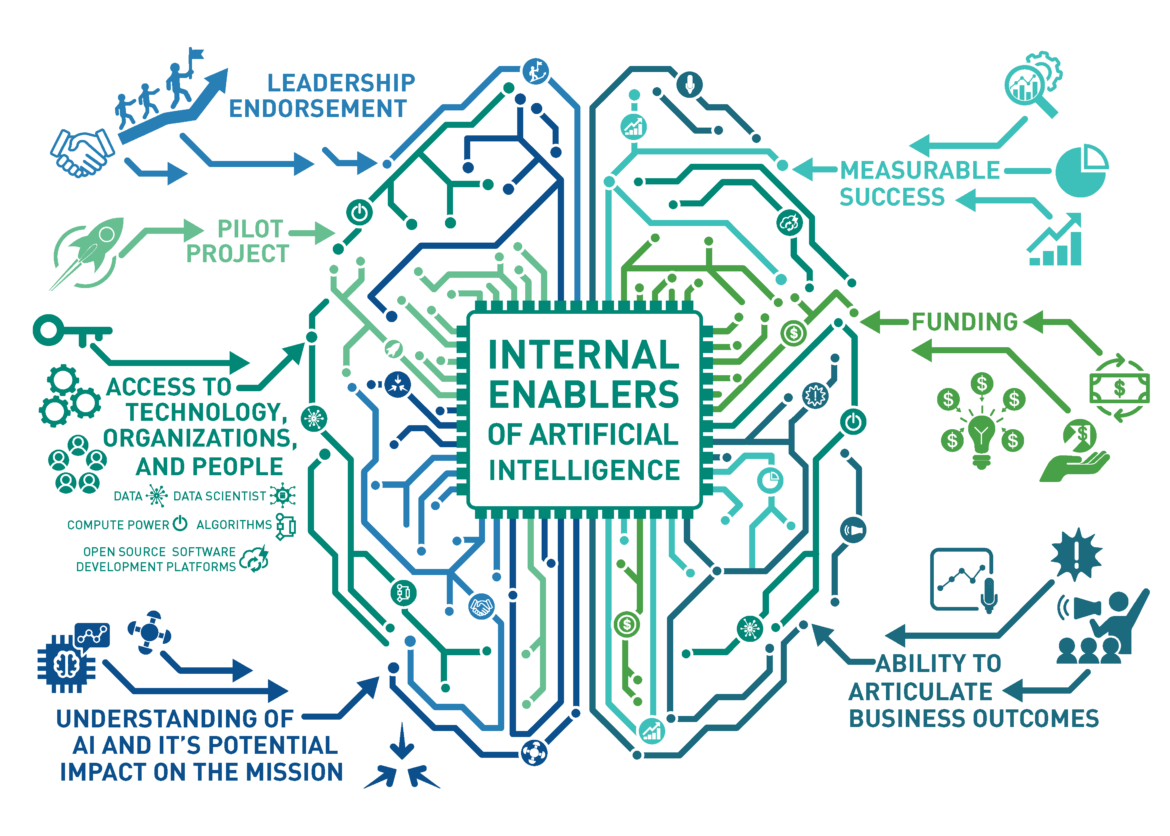
HOW TO SOLVE ARTIFICIAL INTELLIGENCE ISSUES
Internal_Enablers_of_AI.png


Reengineering: There is a great opportunity to redesign business processes and tasks around AI.

Organization and Culture—AI is the child of big data and analytics, and is likely to be subject to the same organization and culture issues as the parent.

Transparency - Companies should focus on increasing AI transparency by tackling poor quality and unlabeled data.

Investment—One key driver to improve artificial intelligence challenges is to invest in research & development. Few companies are demanding ROI analysis both before and after implementation.

CONCLUSION
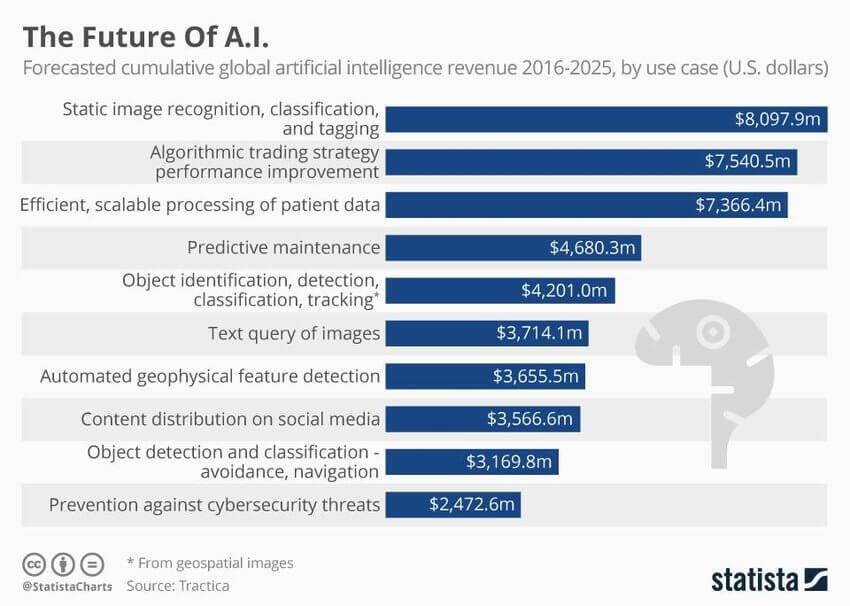
The_Future_of_AI_2016-2025.jpeg


© Statista

In order to ensure appropriate utilization of artificial intelligence, companies need to embrace techniques that help them achieve fairness, security, and explainability. Responsible implementation of AI must reflect the ethics and values of an organization, thus, building trust among its customers, employees, and other stakeholders. 

There is no doubt that the benefits and challenges of advanced technologies like AI are endless, but in seeking these new opportunities, we risk compromising the privacy and integrity of our society and its members. No matter what you may have heard, AI isn't going to solve all your problems. If you want to get the most out of AI, it's important to have the right expectations to avoid setting your team up for disappointment.

Thursday, 27 June 2019

Uli Ap Artificial Intelligence of Virtual Reality

Artificial Intelligence of Virtual Reality is a survey of Uli Ap’s site-specific immersive installations disorienting the visitor in a cross-reality zone between virtual, physical, and mental realms. Selected installations deal with issues of sacred and transitional spaces that generate sound through immediate interaction. Enveloped by soundscapes of Sacred Danger and That Side Where Real Is, you enter the altar of Anti-Gravity Reality: Inside the Black Cube or Brain AI transporting you into a transdisciplinary encounter between Virtual Reality, Artificial Intelligence, Robotics, and Neuroscience. There, you donate your emotions to a machine. Sounds at interventions to provoke your anxiety are the ones of Sacred Danger and That Side Where Real Is. All installations are connected. And standing in the middle of the ineradicably vast space of Ambika P3 you hear them merging with a sound of your heartbeat.
Installations:
Anti-Gravity Reality: Inside the Black Cube or Brain AI [prototype] Sacred Danger [Part II] [the Kim Fielding Award for experimental arts] That Side Where Real Is [Crypt@St.Mark’s St Mark’s Church Kennington] Red Film & The cReature Film
ANTI-GRAVITY REALITY: INSIDE THE BLACK CUBE OR BRAIN AI is an interactive cross-
reality installation that collides Virtual (VR), Physical, and Mental Realities.

Human emotions and feelings are being consumed by a living AI organism in order to create itself in both virtual and physical realms. The system measures your anxiety level and feeds itself with it through biofeedback sensors. Biosignals from electroencephalogram (EEG), galvanic skin response (GSR), and pulse sensor manipulate the environment. Virtual Reality acquires Physical qualities and tactile sensations. The experience is totally disorienting. Interacting with structures produced by their own brain, a participant unknowingly becomes a performer. Each experience will be unique and the space constructed at its culmination will be catalogued and transformed into an outside anti-gravitational pavilion. Recorded, it will travel to a gallery again as 360 VR installation.
The project merges art, science, and technology and stands for erasing labels, identities, disciplines, and geographical borders by advocating freedom of choice and movement. At no given moment, a participant is sure whether they are still in virtual or already in physical space. Or might be somewhere in space of their own imagination. It is a transdisciplinary encounter between Virtual Reality, Artificial Intelligence, Neuroscience, and Robotics.
SACRED DANGER [the Kim Fielding Award for experimental arts]
Part I: outside installation Part II: multi-channel sound-video installation transferring experience of a physically built space through the digital realms
Sacred Danger – immersive site-specific outside installation or a structural intervention in a landscape reinventing a sacred space. A project is inspired by my research trip to Blaenau Ffesteniog in North Wales, where I have been taken by local people to abandoned slate queries. By experiencing a sensation of the innermost fear and danger during this journey – those slate queries could collapse any time – I have compared them to Gothic cathedrals, that one of a beauty and attractive seduction though simultaneously the one of a danger and manipulation.
Visible from far away fields, Sacred Danger sits on a sharply inclined hill like a weightless cloud inviting you to enter into its inside. Although, the very moment you find yourself there, a situation is reversed into insecurity and vulnerability by exposing your body to the attack of a fluctuating under the strong wind structure built out of just 6mm plexiglass penetrated by massive 1inch steel rods. Dragon shape of a zig-zag foundation is confusing in its refractive magnifying reflections, and willing to escape to a stunning sea side horizon you are bounded to a disappointment – you are inside the space with no exit. The exit is blocked by a transparent plexiglass which obviously you do not see unless by touching it on approaching. In effect, you would try to exit Sacred Danger on every turn of a dragon only to realise that transparency is an illusion and all your senses and perceptions are disoriented. Chameleonic nature of Sacred Danger, with a great sensitivity reacting on each of the atmospheric conditions, makes the
structure change its appearance within nearly every hour. Transparent throughout the day. Frosted in the early morning by dense fog. Turning flaming red in the sunset. With sliding raindrops in the evening. The structure claims its own presence to be unbelievable. A space with no exit dissolves in nature by confronting it. Triggers the mind by challenging and provoking it. Delusional crystal clear transparency of plexiglass transforms Sacred Danger into a totally invisible volume suspending threaded bars in the air. It is deliberately created to transfer the feeling of insecurity, instability and danger – you just simply don’t believe that the structure holds itself up – and this is exactly how it should be. Though, each experience would be totally different, somehow you are supposed to be scared inside – and so you do.
On entering Sacred Danger through a hole in a bush, you are signing an agreement with nature by excepting a possibility of the existence of something that logically could not have ever existed.
THAT SIDE WHERE REAL IS
9 site-specific immersive Installations challenging our perceptions of reality Crypt@St.Mark’s Kennington, London, UK [TSWRI] Nine Site-Specific Immersive Installations Questioning Perceptions of Material Reality
& Dream-Like States of Consciousness
Components of ‘That Side Where Real Is’:
Cracking incorporating The cReature film [Room1] Transparent Invisibility [Room2] Suspended Dreams to Eat the Time [Room3] There Is No One In Here [Room4] Vertical Immersion [Room5] All How It Was [Open Room] Black Penetration Into And Through Horizontal Dimensions [Corridor. Part I] Black Penetration Into And Through Horizontal Dimensions [Corridor. Part II] Red Gloss One String [Entry Hall]
Multi-component installation ‘That Side Where Real Is’ – is a series of physically constructed, site-specific, inter-connected installations challenging our perception of space and the idea of the space as such built from ephemeral materials or materials that become ephemeral when being constructed into the space. To go through the installation is mentally, intellectually and emotionally intense experience activated by constantly changing hallucinational spaces on the way you move. At the installation context, a body becomes a tool penetrating a space [human element penetration] confronting a built environment battling with the dissolution and vagueness.
The exhibition’s title, ‘That Side Where Real Is’ refers both to the visual challenges conveyed through the materials used and the way they trick the mind by disorienting the body, making it to squeeze in-between something that seems to be impossible to enter, perceive something that human eyes cannot simply see unless they are positioned at certain angles or fixed at the points of the space where the light is reflected. Emotionally and intellectually challenging chameleonic geometry that constantly changes into hallucinational spaces while your body is moving. It is a division between physical and abstract, rational and intuitive – with a big question mark on which of them is real.
A peculiarity of the site is echoed in here – being in an underground crypt, empty and dark, with the whole universe of life happening on the upper layer inside the building of the church itself; and, then, beyond the point of the church – in a real life on the streets. Due to the very nature of the crypt ‘That Side Where Real Is’ deals with a notion of a death/life duality. Sound at the installation is derived from the material elements themselves – be it cracking dry leaves or transparent fishing wire strings, or black elastic shock cords. By reacting on a bodily movement, singular elements generate noises as a response. Those noises are important part of the perception. ‘That Side Where Real Is’ continues to experiment with light, its effect on visibility and depth, and a coloured light as a separate material. The cReature film is as process-based as the overall construction and being organically buried inside dry cracking leaves narratively tells a birth-life-death sequence with the absolute awareness of its senselessness. Being divided on two sides a real has a character of a vague and obscure presence that is constantly transferred in-between. A space of the film prolongs disorienting irony of transparent and invisible strings, deepening it down towards the very extremes.
Uli Ap Artificial Intelligence of Virtual Reality Ambika P3 University of Westminster
35 Marylebone Road London NW1 5LS [entrance through the main reception]
About The Artist
Uli Ap is a trans-disciplinary artist researching into a cross-reality zone between virtual, physical and mental spaces where definitions between the mediums and disciplines are no longer possible. Provocatively colliding art, science, technology, architecture, and journalism, the artist creates intellectually challenging and bodily disorienting site-specific immersive interactive installations to question our perceptions of the self and various levels of reality.
Uli lives and works in London and travels the world extensively to exhibit and take part in art residencies. Ap undertook artist’s residencies in the British School at Rome, ‘International
Artist-in-Residence’ in Aso, Minamioguni-machi, Japan, received inaugural Kim Fielding Award for experimental arts, Cardiff, Wales and Emerging Artists Promotions Grant, London, UK. Ambika P3 exhibition gives a comprehensive insight into the artist’s practice. Uli Ap’s work is included at the forthcoming “Weather the Weather” a SciArt Initiative exhibition at the New York Hall of Science.
Ambika P3 is a 14,000 square ft space developed from the vast former concrete construction hall for the University of Westminster’s School of Engineering. Built in the 1960s, it is a distinctive space for contemporary art and architecture which presents a public programme of solo and group exhibitions, education projects and talks and events involving the academic community from the Faculty of Architecture and Built Environment and Westminster School ofMedia, Arts and Design.

Rank

seo