Welcome to our Coding with python Page!!! hier you find various code with PHP, Python, AI, Cyber, etc ... Electricity, Energy, Nuclear Power

Showing posts with label Neural Networks. Show all posts

Monday, 11 October 2021

Neural Networks: Advantages and Applications

All about Agile, Ansible, DevOps, Docker, EXIN, Git, ICT, Jenkins, Kubernetes, Puppet, Selenium, Python, etc

A human brain is not capable of solving complex data and cannot extract information from compound structures. To overcome this lack of ability to resolve complex problems, Warren McCulloch and Walter Pitts came up with a mathematical model. This model is called Artificial Neural Networks(ANN) which falls under Artificial Intelligence. The ANN is a computing system designed to replicate the way humans analyze and work. The processing of multiple data inputs is done by different machine learning algorithms. These algorithms work together under a single framework called the neural network. Neural networks are inspired by the structure of biological neural networks in a human brain. There is an input neuron which acts as an interface for all the other neurons to pass the input. Also, there is an output neuron which accepts all the outputs from different neurons.


Artificial Neural Networks are composed of many nodes. These nodes are connected to each other and function together, by passing information. They consist of a number of layers called Multi-Layer Perceptron(MLP). Here, each layer performs a different function on the received data. These layers include one input layer, one output layer, and one or more hidden layers. The basic data is received by the input layer. The hidden layers extract data from one set of neurons (input layer) and provide the output to another set of neurons (output layer), hence they remain hidden. The hidden layers, as they go deeper, capture all the minute details. This results in discovering various relationships between different inputs. Finally, the output layer provides a result which is simple and understandable.

The Neural Network is first given a set of high-level input data which the system reads and analyzes. The system then detects the properties of the inputs, layer by layer. In case of an image, the first layer may detect the contrast and the next layer may detect the texture. In a similar way, different attributes are detected by different layers. If the data of a cat is provided in the form of images then, the system starts to recognize cats from the rest of the inputs, provided for detecting. The network perceives better when a descriptive input or rules are also provided to it like, a cat has whiskers or has spots. It also adjusts its internal weightings to the answers provided to it. That is, the network adds weight to the input sources that provide the information, based on how reliable they are. This helps in improving its performance each time.

Types of Neural Networks:

The Neural Networks are divided into types based on the number of hidden layers they contain or how deep the network goes. Each type has its own levels of complexity and use cases. Few types of neural networks are Feed-forward neural network, Recurrent neural network, Convolutional neural network and Hopfield networks

  • Feed-forward neural networks:
    Feed-forward neural network are the basic type of neural networks. The information in this network travels in a unidirectional manner, that is, only from input to processing node to output. The hidden layers may or may not be present in this type, making it more explicable.


  • Recurrent neural networks:
    Recurrent neural networks are much more complex and most widely used networks. The data flows in multiple directions in this network. They store the output data of the processing nodes and learn to improve their functioning.
  • Convolutional neural networks:
    Convolutional neural networks are the ones that are popular today due to their specialty in being able to perform face recognition. They allow encoding attributes into the input, by assuming it to be an image.

Advantages of Neural Networks:

  • Neural Networks have the ability to learn by themselves and produce the output that is not limited to the input provided to them.
  • The input is stored in its own networks instead of a database, hence the loss of data does not affect its working.
  • These networks can learn from examples and apply them when a similar event arises, making them able to work through real-time events.
  • Even if a neuron is not responding or a piece of information is missing, the network can detect the fault and still produce the output.
  • They can perform multiple tasks in parallel without affecting the system performance.

Applications of Neural Networks:

The Artificial Neural Network has been in existence from 1943, when it was initially designed, but has only recently come into light under Artificial Intelligence due to the applications that make it more preferable. These include:

  • Image processing
  • Language processing and translation
  • Route detection
  • Speech recognition
  • Forecasting

Artificial Neural Networks are currently being used to solve many complex problems and the demand is increasing with time. The wide number of applications starting from face recognition to making decisions are being handled by neural networks.

The more it is exposed to real-time examples, the more it adapts. Neural Networks are capable of learning from faults thereby increasing its capacity to perform well. Hence, neural networks are being preferred more for complex problem-solvin


Wednesday, 6 October 2021

How Artificial Intelligence Is Changing Scienc

artificial intelligence, astronomy, astrophysics, computational astrophysics, computer science, machine learning, neural networks, physics, podcast

The latest AI algorithms are probing the evolution of galaxies, calculating quantum wave functions, discovering new chemical compounds and more. Is there anything that scientists do that can’t be automated?
No human, or team of humans, could possibly keep up with the avalanche of information produced by many of today’s physics and astronomy experiments. Some of them record terabytes of data every day — and the torrent is only increasing. The Square Kilometer Array, a radio telescope slated to switch on in the mid-2020s, will generate about as much data traffic each year as the entire internet.

The deluge has many scientists turning to artificial intelligence for help. With minimal human input, AI systems such as artificial neural networks — computer-simulated networks of neurons that mimic the function of brains — can plow through mountains of data, highlighting anomalies and detecting patterns that humans could never have spotted.


Of course, the use of computers to aid in scientific research goes back about 75 years, and the method of manually poring over data in search of meaningful patterns originated millennia earlier. But some scientists are arguing that the latest techniques in machine learning and AI represent a fundamentally new way of doing science. One such approach, known as generative modeling, can help identify the most plausible theory among competing explanations for observational data, based solely on the data, and, importantly, without any preprogrammed knowledge of what physical processes might be at work in the system under study. Proponents of generative modeling see it as novel enough to be considered a potential “third way” of learning about the universe.

Traditionally, we’ve learned about nature through observation. Think of Johannes Kepler poring over Tycho Brahe’s tables of planetary positions and trying to discern the underlying pattern. (He eventually deduced that planets move in elliptical orbits.) Science has also advanced through simulation. An astronomer might model the movement of the Milky Way and its neighboring galaxy, Andromeda, and predict that they’ll collide in a few billion years. Both observation and simulation help scientists generate hypotheses that can then be tested with further observations. Generative modeling differs from both of these approaches.

“It’s basically a third approach, between observation and simulation,” says Kevin Schawinski, an astrophysicist and one of generative modeling’s most enthusiastic proponents, who worked until recently at the Swiss Federal Institute of Technology in Zurich (ETH Zurich). “It’s a different way to attack a problem.”

Some scientists see generative modeling and other new techniques simply as power tools for doing traditional science. But most agree that AI is having an enormous impact, and that its role in science will only grow. Brian Nord, an astrophysicist at Fermi National Accelerator Laboratory who uses artificial neural networks to study the cosmos, is among those who fear there’s nothing a human scientist does that will be impossible to automate. “It’s a bit of a chilling thought,” he said.

Discovery by Generation

Ever since graduate school, Schawinski has been making a name for himself in data-driven science. While working on his doctorate, he faced the task of classifying thousands of galaxies based on their appearance. Because no readily available software existed for the job, he decided to crowdsource it — and so the Galaxy Zoo citizen science project was born. Beginning in 2007, ordinary computer users helped astronomers by logging their best guesses as to which galaxy belonged in which category, with majority rule typically leading to correct classifications. The project was a success, but, as Schawinski notes, AI has made it obsolete: “Today, a talented scientist with a background in machine learning and access to cloud computing could do the whole thing in an afternoon.”

Schawinski turned to the powerful new tool of generative modeling in 2016. Essentially, generative modeling asks how likely it is, given condition X, that you’ll observe outcome Y. The approach has proved incredibly potent and versatile. As an example, suppose you feed a generative model a set of images of human faces, with each face labeled with the person’s age. As the computer program combs through these “training data,” it begins to draw a connection between older faces and an increased likelihood of wrinkles. Eventually it can “age” any face that it’s given — that is, it can predict what physical changes a given face of any age is likely to undergo.

None of these faces is real. The faces in the top row (A) and left-hand column (B) were constructed by a generative adversarial network (GAN) using building-block elements of real faces. The GAN then combined basic features of the faces in A, including their gender, age and face shape, with finer features of faces in B, such as hair color and eye color, to create all the faces in the rest of the grid.

Adapted from NVIDIA

The best-known generative modeling systems are “generative adversarial networks” (GANs). After adequate exposure to training data, a GAN can repair images that have damaged or missing pixels, or they can make blurry photographs sharp. They learn to infer the missing information by means of a competition (hence the term “adversarial”): One part of the network, known as the generator, generates fake data, while a second part, the discriminator, tries to distinguish fake data from real data. As the program runs, both halves get progressively better. You may have seen some of the hyper-realistic, GAN-produced “faces” that have circulated recently — images of “freakishly realistic people who don’t actually exist,” as one headline put it.

More broadly, generative modeling takes sets of data (typically images, but not always) and breaks each of them down into a set of basic, abstract building blocks — scientists refer to this as the data’s “latent space.” The algorithm manipulates elements of the latent space to see how this affects the original data, and this helps uncover physical processes that are at work in the system.

The idea of a latent space is abstract and hard to visualize, but as a rough analogy, think of what your brain might be doing when you try to determine the gender of a human face. Perhaps you notice hairstyle, nose shape, and so on, as well as patterns you can’t easily put into words. The computer program is similarly looking for salient features among data: Though it has no idea what a mustache is or what gender is, if it’s been trained on data sets in which some images are tagged “man” or “woman,” and in which some have a “mustache” tag, it will quickly deduce a connection.

In a paper published in December in Astronomy & Astrophysics, Schawinski and his ETH Zurich colleagues Dennis Turp and Ce Zhang used generative modeling to investigate the physical changes that galaxies undergo as they evolve. (The software they used treats the latent space somewhat differently from the way a generative adversarial network treats it, so it is not technically a GAN, though similar.) Their model created artificial data sets as a way of testing hypotheses about physical processes. They asked, for instance, how the “quenching” of star formation — a sharp reduction in formation rates — is related to the increasing density of a galaxy’s environment.

For Schawinski, the key question is how much information about stellar and galactic processes could be teased out of the data alone. “Let’s erase everything we know about astrophysics,” he said. “To what degree could we rediscover that knowledge, just using the data itself?”

First, the galaxy images were reduced to their latent space; then, Schawinski could tweak one element of that space in a way that corresponded to a particular change in the galaxy’s environment — the density of its surroundings, for example. Then he could re-generate the galaxy and see what differences turned up. “So now I have a hypothesis-generation machine,” he explained. “I can take a whole bunch of galaxies that are originally in a low-density environment and make them look like they’re in a high-density environment, by this process.”  Schawinski, Turp and Zhang saw that, as galaxies go from low- to high-density environments, they become redder in color, and their stars become more centrally concentrated. This matches existing observations about galaxies, Schawinski said. The question is why this is so.

The next step, Schawinski says, has not yet been automated: “I have to come in as a human, and say, ‘OK, what kind of physics could explain this effect?’” For the process in question, there are two plausible explanations: Perhaps galaxies become redder in high-density environments because they contain more dust, or perhaps they become redder because of a decline in star formation (in other words, their stars tend to be older). With a generative model, both ideas can be put to the test: Elements in the latent space related to dustiness and star formation rates are changed to see how this affects galaxies’ color. “And the answer is clear,” Schawinski said. Redder galaxies are “where the star formation had dropped, not the ones where the dust changed. So we should favor that explanation.”

Using generative modeling, astrophysicists could investigate how galaxies change when they go from low-density regions of the cosmos to high-density regions, and what physical processes are responsible for these changes.

Adapted from K. Schawinski et al.; Source doi: 10.1051/0004-6361/201833800

The approach is related to traditional simulation, but with critical differences. A simulation is “essentially assumption-driven,” Schawinski said. “The approach is to say, ‘I think I know what the underlying physical laws are that give rise to everything that I see in the system.’ So I have a recipe for star formation, I have a recipe for how dark matter behaves, and so on. I put all of my hypotheses in there, and I let the simulation run. And then I ask: Does that look like reality?” What he’s done with generative modeling, he said, is “in some sense, exactly the opposite of a simulation. We don’t know anything; we don’t want to assume anything. We want the data itself to tell us what might be going on.”

The apparent success of generative modeling in a study like this obviously doesn’t mean that astronomers and graduate students have been made redundant — but it appears to represent a shift in the degree to which learning about astrophysical objects and processes can be achieved by an artificial system that has little more at its electronic fingertips than a vast pool of data. “It’s not fully automated science — but it demonstrates that we’re capable of at least in part building the tools that make the process of science automatic,” Schawinski said.

Generative modeling is clearly powerful, but whether it truly represents a new approach to science is open to debate. For David Hogg, a cosmologist at New York University and the Flatiron Institute (which, like Quanta, is funded by the Simons Foundation), the technique is impressive but ultimately just a very sophisticated way of extracting patterns from data — which is what astronomers have been doing for centuries. In other words, it’s an advanced form of observation plus analysis. Hogg’s own work, like Schawinski’s, leans heavily on AI; he’s been using neural networks to classify stars according to their spectra and to infer other physical attributes of stars using data-driven models. But he sees his work, as well as Schawinski’s, as tried-and-true science. “I don’t think it’s a third way,” he said recently. “I just think we as a community are becoming far more sophisticated about how we use the data. In particular, we are getting much better at comparing data to data. But in my view, my work is still squarely in the observational mode.”

Hardworking Assistants

Whether they’re conceptually novel or not, it’s clear that AI and neural networks have come to play a critical role in contemporary astronomy and physics research. At the Heidelberg Institute for Theoretical Studies, the physicist Kai Polsterer heads the astroinformatics group — a team of researchers focused on new, data-centered methods of doing astrophysics. Recently, they’ve been using a machine-learning algorithm to extract redshift information from galaxy data sets, a previously arduous task.

Polsterer sees these new AI-based systems as “hardworking assistants” that can comb through data for hours on end without getting bored or complaining about the working conditions. These systems can do all the tedious grunt work, he said, leaving you “to do the cool, interesting science on your own.”

But they’re not perfect. In particular, Polsterer cautions, the algorithms can only do what they’ve been trained to do. The system is “agnostic” regarding the input. Give it a galaxy, and the software can estimate its redshift and its age — but feed that same system a selfie, or a picture of a rotting fish, and it will output a (very wrong) age for that, too. In the end, oversight by a human scientist remains essential, he said. “It comes back to you, the researcher. You’re the one in charge of doing the interpretation.”

For his part, Nord, at Fermilab, cautions that it’s crucial that neural networks deliver not only results, but also error bars to go along with them, as every undergraduate is trained to do. In science, if you make a measurement and don’t report an estimate of the associated error, no one will take the results seriously, he said.

Like many AI researchers, Nord is also concerned about the impenetrability of results produced by neural networks; often, a system delivers an answer without offering a clear picture of how that result was obtained.

Yet not everyone feels that a lack of transparency is necessarily a problem. Lenka ZdeborovĂĄ, a researcher at the Institute of Theoretical Physics at CEA Saclay in France, points out that human intuitions are often equally impenetrable. You look at a photograph and instantly recognize a cat — “but you don’t know how you know,” she said. “Your own brain is in some sense a black box.”

It’s not only astrophysicists and cosmologists who are migrating toward AI-fueled, data-driven science. Quantum physicists like Roger Melko of the Perimeter Institute for Theoretical Physics and the University of Waterloo in Ontario have used neural networks to solve some of the toughest and most important problems in that field, such as how to represent the mathematical “wave function” describing a many-particle system. AI is essential because of what Melko calls “the exponential curse of dimensionality.” That is, the possibilities for the form of a wave function grow exponentially with the number of particles in the system it describes. The difficulty is similar to trying to work out the best move in a game like chess or Go: You try to peer ahead to the next move, imagining what your opponent will play, and then choose the best response, but with each move, the number of possibilities proliferates.

Of course, AI systems have mastered both of these games — chess, decades ago, and Go in 2016, when an AI system called AlphaGo defeated a top human player. They are similarly suited to problems in quantum physics, Melko says.

The Mind of the Machine

Whether Schawinski is right in claiming that he’s found a “third way” of doing science, or whether, as Hogg says, it’s merely traditional observation and data analysis “on steroids,” it’s clear AI is changing the flavor of scientific discovery, and it’s certainly accelerating it. How far will the AI revolution go in science?

Occasionally, grand claims are made regarding the achievements of a “robo-scientist.” A decade ago, an AI robot chemist named Adam investigated the genome of baker’s yeast and worked out which genes are responsible for making certain amino acids. (Adam did this by observing strains of yeast that had certain genes missing, and comparing the results to the behavior of strains that had the genes.)  Wired’s headline read, “Robot Makes Scientific Discovery All by Itself.”

More recently, Lee Cronin, a chemist at the University of Glasgow, has been using a robot to randomly mix chemicals, to see what sorts of new compounds are formed. Monitoring the reactions in real-time with a mass spectrometer, a nuclear magnetic resonance machine, and an infrared spectrometer, the system eventually learned to predict which combinations would be the most reactive. Even if it doesn’t lead to further discoveries, Cronin has said, the robotic system could allow chemists to speed up their research by about 90 percent.

Last year, another team of scientists at ETH Zurich used neural networks to deduce physical laws from sets of data. Their system, a sort of robo-Kepler, rediscovered the heliocentric model of the solar system from records of the position of the sun and Mars in the sky, as seen from Earth, and figured out the law of conservation of momentum by observing colliding balls. Since physical laws can often be expressed in more than one way, the researchers wonder if the system might offer new ways — perhaps simpler ways — of thinking about known laws.

These are all examples of AI kick-starting the process of scientific discovery, though in every case, we can debate just how revolutionary the new approach is. Perhaps most controversial is the question of how much information can be gleaned from data alone — a pressing question in the age of stupendously large (and growing) piles of it. In The Book of Why (2018), the computer scientist Judea Pearl and the science writer Dana Mackenzie assert that data are “profoundly dumb.” Questions about causality “can never be answered from data alone,” they write. “Anytime you see a paper or a study that analyzes the data in a model-free way, you can be certain that the output of the study will merely summarize, and perhaps transform, but not interpret the data.” Schawinski sympathizes with Pearl’s position, but he described the idea of working with “data alone” as “a bit of a straw man.” He’s never claimed to deduce cause and effect that way, he said. “I’m merely saying we can do more with data than we often conventionally do.”

Another oft-heard argument is that science requires creativity, and that — at least so far — we have no idea how to program that into a machine. (Simply trying everything, like Cronin’s robo-chemist, doesn’t seem especially creative.) “Coming up with a theory, with reasoning, I think demands creativity,” Polsterer said. “Every time you need creativity, you will need a human.” And where does creativity come from? Polsterer suspects it is related to boredom — something that, he says, a machine cannot experience. “To be creative, you have to dislike being bored. And I don’t think a computer will ever feel bored.” On the other hand, words like “creative” and “inspired” have often been used to describe programs like Deep Blue and AlphaGo. And the struggle to describe what goes on inside the “mind” of a machine is mirrored by the difficulty we have in probing our own thought processes.

Schawinski recently left academia for the private sector; he now runs a startup called Modulos which employs a number of ETH scientists and, according to its website, works “in the eye of the storm of developments in AI and machine learning.”  Whatever obstacles may lie between current AI technology and full-fledged artificial minds, he and other experts feel that machines are poised to do more and more of the work of human scientists. Whether there is a limit remains to be seen.

“Will it be possible, in the foreseeable future, to build a machine that can discover physics or mathematics that the brightest humans alive are not able to do on their own, using biological hardware?” Schawinski wonders. “Will the future of science eventually necessarily be driven by machines that operate on a level that we can never reach? I don’t know. It’s a good question.”

This article was reprinted on Wired.com.


Sunday, 3 October 2021

Artificial Intelligence & Autopilot

We develop and deploy autonomy at scale in vehicles, robots and more. We believe that an approach based on advanced AI for vision and planning, supported by efficient use of inference hardware, is the only way to achieve a general solution for full self-driving and beyond.

FSD Chip

Build AI inference chips to run our Full Self-Driving software, considering every small architectural and micro-architectural improvement while squeezing maximum silicon performance-per-watt. Perform floor-planning, timing and power analyses on the design. Write robust tests and scoreboards to verify functionality and performance. Implement drivers to program and communicate with the chip, focusing on performance optimization and redundancy. Finally, validate the silicon chip and bring it to mass production in our vehicles.


Dojo Chip

Build AI training chips to power our Dojo system. Implement bleeding-edge technology from the smallest training nodes to the multi-die training tiles. Design and architect for maximum performance, throughput and bandwidth at every granularity. Dictate physical methodology, floor-planning and other physical aspects of the chip. Develop pre-silicon verification and post-silicon validation methods to ensure functional correctness. Write compilers and drivers to optimize power and performance for our neural networks throughout the entire Dojo system.

Dojo Systems

Design and build the Dojo system, from the silicon firmware interfaces to the high-level software APIs meant to control it. Solve hard problems with state-of-the-art technology for high-power delivery and cooling, and write control loops and monitoring software that scales. Work with every aspect of system design where the limit is only your imagination, employing the full prowess of our mechanical, thermal and electrical engineering teams to create the next-generation of machine learning compute for use in Tesla datacenters. Collaborate with Tesla fleet learning to deploy training workloads using our massive datasets, and design a public facing API that will bring Dojo to the masses.

Neural Networks

Apply cutting-edge research to train deep neural networks on problems ranging from perception to control. Our per-camera networks analyze raw images to perform semantic segmentation, object detection and monocular depth estimation. Our birds-eye-view networks take video from all cameras to output the road layout, static infrastructure and 3D objects directly in the top-down view. Our networks learn from the most complicated and diverse scenarios in the world, iteratively sourced from our fleet of nearly 1M vehicles in real time. A full build of Autopilot neural networks involves 48 networks that take 70,000 GPU hours to train đŸ”„. Together, they output 1,000 distinct tensors (predictions) at each timestep.

Autonomy Algorithms

Develop the core algorithms that drive the car by creating a high-fidelity representation of the world and planning trajectories in that space. In order to train the neural networks to predict such representations, algorithmically create accurate and large-scale ground truth data by combining information from the car's sensors across space and time. Use state-of-the-art techniques to build a robust planning and decision-making system that operates in complicated real-world situations under uncertainty. Evaluate your algorithms at the scale of the entire Tesla fleet.

Code Foundations

Throughput, latency, correctness and determinism are the main metrics we optimize our code for. Build the Autopilot software foundations up from the lowest levels of the stack, tightly integrating with our custom hardware. Implement super-reliable bootloaders with support for over-the-air updates and bring up customized Linux kernels. Write fast, memory-efficient low-level code to capture high-frequency, high-volume data from our sensors, and to share it with multiple consumer processes— without impacting central memory access latency or starving critical functional code from CPU cycles. Squeeze and pipeline compute across a variety of hardware processing units, distributed across multiple system-on-chips.

Evaluation Infrastructure

Build open- and closed-loop, hardware-in-the-loop evaluation tools and infrastructure at scale, to accelerate the pace of innovation, track performance improvements and prevent regressions. Leverage anonymized characteristic clips from our fleet and integrate them into large suites of test cases. Write code simulating our real-world environment, producing highly realistic graphics and other sensor data that feed our Autopilot software for live debugging or automated testing.


Tesla Bot

Develop the next generation of automation, including a general purpose, bi-pedal, humanoid robot capable of performing tasks that are unsafe, repetitive or boring. We’re seeking mechanical, electrical, controls and software engineers to help us leverage our AI expertise beyond our vehicle fleet.

Monday, 27 September 2021

Cheat Sheets for AI, Neural Networks, Machine Learning, Deep Learning & Big Data

All about Agile, Ansible, DevOps, Docker, EXIN, Git, ICT, Jenkins, Kubernetes, Puppet, Selenium, Python, etc

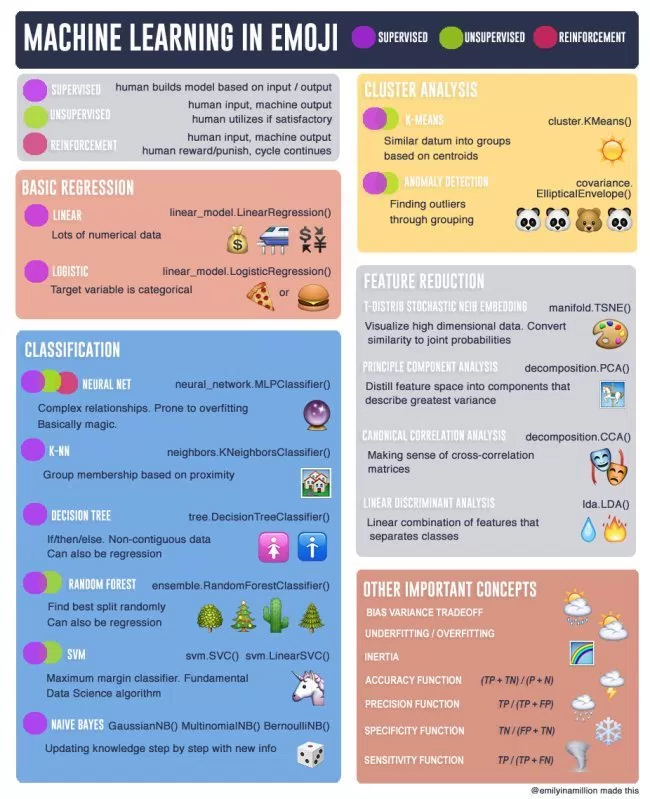
Over the past few months, I have been collecting AI cheat sheets. From time to time I share them with friends and colleagues and recently I have been getting asked a lot, so I decided to organize and share the entire collection. To make things more interesting and give context, I added descriptions and/or excerpts for each major topic.

This is the most complete list and the Big-O is at the very end, enjoy…

>>> Update: We have recently redesigned these cheat sheets into a Super High Definition PDF. Check them out below:

Neural Networks Cheat Sheet

>>> If you like this list, you can let me know here.<<<

Neural Networks Graphs

Neural Networks Graphs Cheat Sheet

Machine Learning Overview

Machine Learning Cheat She

Machine Learning: Scikit-learn algorithm

This machine learning cheat sheet will help you find the right estimator for the job which is the most difficult part. The flowchart will help you check the documentation and rough guide of each estimator that will help you to know more about the problems and how to solve it.

Machine Learning Cheat Sheet
more details


Rank

seo