-->

Welcome to our Coding with python Page!!! hier you find various code with PHP, Python, AI, Cyber, etc ... Electricity, Energy, Nuclear Power

Showing posts with label Data Visualization. Show all posts

Monday, 1 May 2023

FREE Udacity Courses on Data Analytics, SQL & Data Visualization

FREE Udacity Courses on Data Analytics, SQL & Data Visualization


1. Intro to Data Analysis

Time to Complete– 6 Weeks

This is a completely free course and a good first step towards understanding the data analysis process. In this course, you will learn the entire data analysis process including posing a question, data wrangling, exploring the data, drawing conclusions, and communicating your findings. This course will also teach Python libraries NumPy, Pandas, and Matplotlib.

You Should Enroll if-

  • You are comfortable with Python programming.

Interested to Enroll?

If yes, then start learning- Intro to Data Analysis

2. SQL for Data Analysis

Time to Complete- 4 weeks

This course is completely free and covers SQL to extract and analyze data stored in databases. SQL is used to perform data analysis in this course. First, you will learn SQL basics like how to extract data, SQL joins to join tables and SQL aggregations.

Then you will learn how to perform complex analysis and manipulations using subqueries, temp tables, and window functions. 

You Should Enroll if-

  • You have general familiarity working with data in spreadsheets.

Interested to Enroll?

If yes, then start learning- SQL for Data Analysis

3. Data Analysis with R

Time to Complete- 2 Months

This is an intermediate-level free course to learn data analysis using R programming. This course begins with the introduction of exploratory data analysis (EDA). Then you will learn R basics by installing RStudio and packages.

After that, you will perform EDA to understand a variable’s distribution and check for anomalies and outliers. You will also learn how to quantify and visualize individual variables within a data set to make sense of a pseudo-data set of Facebook users.

In this course, you will work on the Diamonds and Price Predictions project. In this project, you will investigate the diamond data set and see how predictive modeling can allow us to determine a good price for a diamond.

You Should Enroll if-

  • You have prior knowledge of statistics.

Interested to Enroll?

If yes, then start learning- Data Analysis with R

4. Data Analysis and Visualization

Time to Complete- 16 Weeks

This is another free course for learning data analysis and visualization. In this course, you will understand the different techniques and theories behind data analysis and visualization. You will also learn how to write programs and scripts that analyze and visualize the data.

R programming language is used in this course. In this course, you will also learn how to model data using logistics regression and linear regression. At the last of this course, you will learn how to handle high-dimensional data effectively using regularization.

You Should Enroll if-

  • You have prior programming experience and are familiar with mathematics (basic linear algebra, calculus, introductory probability).

Interested to Enroll?

If yes, then start learning- Data Analysis and Visualization

5. Data Visualization in Tableau

Time to Complete- 3 Weeks

This free course will teach data visualization using Tableau. The course begins with the fundamentals of data visualization such as why visualization is so important in analytics, exploratory versus explanatory visualizations, and data types and ways to encode data.

Then you will learn design principles such as how to use chart type, color, size, and shape to get the most out of data visualizations. After learning design principles, you will learn Tableau and basic functions in Tableau, like inputting data and building charts.

This course also teaches how to build Tableau dashboards and how to create visualizations to tell stories with data.

You Should Enroll if-

  • You have no programming experience but are interested in using data to make better business decisions.

Interested to Enroll?

If yes, then start learning- Data Visualization in Tableau

6.  Data Visualization and D3.js

Time to Complete- 7 Weeks

This is a completely free course to learn data visualization. In this course, you will understand the fundamentals of data visualization and learn how to represent data values in visual form.

Then you will learn how to use the open standards of the web to create a graphical element, which chart type to use for a data set, and colors to avoid when making graphics.

After that, you will learn how to create graphics using the Dimple JavaScript library,  how to incorporate different narrative structures into your visualizations, and bias in the data visualization process.

At the end of this course, you will learn how to leverage animation and interaction to bring more data insights to your audience and how to create a bubble map for the World Cup data set.

You Should Enroll if-

  • You are familiar with basic programming principles, including data types, If else statements, for loopsfunctions, and objects.

Interested to Enroll?

If yes, then start learning- Data Visualization and D3.js

7. Intro to Relational Databases

Time to Complete- 4 weeks

Best For- Intermediate learners

In this Free Course, you will learn the basics of SQL and database design, as well as the Python API for connecting Python code to a database.

You will also learn how to protect your database-backed web apps from common security problems. This course will also teach about normalized design, which makes it easier to write effective code using a database.

At the end of this course, you will learn how to use the SQL join operators to rapidly connect data from different tables.

You Should Enroll if-

  • You can read and write basic code in Python.

Interested to Enroll?

If yes, then start learning- Intro to Relational Databases

8. Big Data Analytics in Healthcare

Time to Complete- 2 months.

This Free Course will cover the characteristics of medical data and associated data mining challenges in dealing with such data. You will learn various algorithms and systems for big data analytics. 

You will also focus on studying those big data techniques in the context of concrete healthcare analytic applications such as predictive modeling, computational phenotyping, and patient similarity. 

This course will also cover Big Data Technologies such as MapReduce, Spark, and Hadoop.

You Should Enroll if-

  • You know basic machine learning and data mining concepts such as classification and clustering and have proficient programming and system skills in Python, Java, and Scala.

Interested to Enroll?

If yes, then check out all details here-Big Data Analytics in Healthcare

9. Data Wrangling with MongoDB

Time to Complete- 2 months.

This is a completely Free Course to explore how to wrangle data from diverse sources and shape it to enable data-driven applications.

This course will cover Data Extraction FundamentalsComplex Data Formats, and a Blueprint for Cleaning.

In this course, you will perform data Modelling in MongoDB and learn Aggregation Operators: $match, $project, $unwind, $group.

You Should Enroll if-

  • You have Programming experience in Python and looking to leverage big data.

Interested to Enroll?

If yes, then check out all details here- Data Wrangling with MongoDB

10. Spark

Time to Complete- 10 hours

This is another completely Free Course to learn how to use Spark to work with big data and build machine learning models at scale, including how to wrangle and model massive datasets with PySpark. PySpark is a Python library for interacting with Spark.

Throughout this course, you will understand the big data ecosystem and learn when to use Spark and when not to use it. This course will also teach Data Wrangling with SparkDebugging, and Optimization.

You will also use Spark’s Machine Learning Library to train machine learning models at scale.

You Should Enroll if-

  • You are a student with programming and data analysis experience.

Interested to Enroll?

If yes, then check out all details here-Spark

11. Intro to Hadoop and MapReduce

Time to Complete- 1 Month

This is a completely Free Course to understand the concepts of HDFS and MapReduce. In this course, you will learn what is big data, the problems big data creates, and how Apache Hadoop addresses these problems.

This course will also help you to discover how HDFS distributes data over multiple computers and how MapReduce enables analyzing datasets in parallel across multiple machines.

In this course, you will also learn how to write your own MapReduce code and how to use common patterns for MapReduce programs to analyze Udacity forum data.

You Should Enroll if-

  • You have basic programming skills in Python.

Interested to Enroll?

If yes, then start learning- Intro to Hadoop and MapReduce

12. Real-Time Analytics with Apache Storm

Time to Complete- 2 weeks

In this free course, you will learn the basic Storm Topologies and how to link to a real-time d3 Word Cloud Visualization using Redis, Flask, and d3.

Next, you will explore open source components by connecting a Rolling Count Bolt to your topology to visualize Rolling Top Tweeted Words.

In your final project, you will follow real-time trending topics by implementing the data pipeline to visualize only tweets that contain Top worldwide hashtags. 

You Should Enroll if-

  • You have intermediate knowledge of Java.

Interested to Enroll?

If yes, then start learning- Real-Time Analytics with Apache Storm

That’s all!

These are the 12 FREE Udacity Courses on Data Analytics, SQL & Data Visualization. Now, it’s time to wrap up.

Conclusion

I hope these  12 FREE Udacity Courses on Data Analytics, SQL & Data Visualization will help you to learn the concepts of data analytics and visualization. My aim is to provide you with the best resources for Learning. If you have any doubts or questions, feel free to ask me in the comment section.

All the Best!

Happy Learning!

Sunday, 17 July 2022

Path to Full Stack Data Science

All about Agile, Ansible, DevOps, Docker, EXIN, Git, ICT, Jenkins, Kubernetes, Puppet, Selenium, Python, etc

#opensource #DEVCommunity #javascript #Flutter #Python #CloudComputing #AWS #DevOps #CloudComputing #Java #100DaysOfCode #AI #React


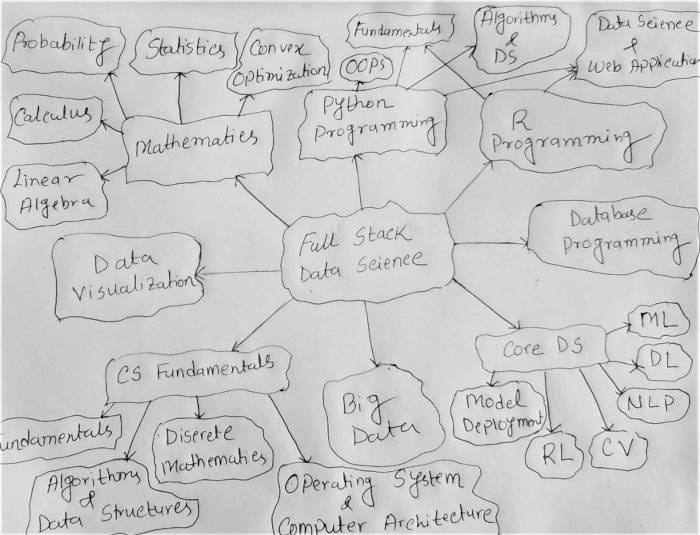
Start your journey toward mastering all aspects of the field of Data Science with this focused list of in-depth self-learning resources. Curated with the beginner in mind, these recommendations will help you learn efficiently, and can also offer existing professionals useful highlights for review or help filling in any gaps in skills.

Full Stack Data Science has become one of the hottest industries in the field of computer science. Starting from traditional mathematics to advance concepts like data engineering, this industry demands a breadth of knowledge and expertise. Its demand has seen an exponential rise in online resources, books, and tutorials. For beginners, it's overwhelming, to say the least. Most of the time, beginners start with either a python course, a machine learning course, or some basic mathematics course. But many times, a large number of them do not know where to start. And with so many resources to go to, many of them keep scraping through resources. Moving between Udemy, edX, Coursera, and YouTube, many hours are lost.

Subject Matters involved with Data Science.

The goal of this article is not to list out the required syllabus but rather list out some of the prominent online resources for each subject area in the end-to-end Data Science domain. It will help beginners start their data science journey without wasting their precious time. I have tried to put down the resources in as much order as possible. But it might vary to a great extent depending upon the individual’s expertise and requirements. The focus of this article is solely the listing out of some of the thorough and in-depth online courses and tutorials available out there for domains comprising full-stack data science. I have tried to keep the list as short as possible so that it helps the starters get started with their learning without much selection.

Download PDF Data Science Books 


Resources for the following areas


  • Mathematics — Linear Algebra, Calculus, Probability, Statistics, and Convex Optimization
  • Python Programming — Fundamentals, OOP Concepts, Algorithms, Data Structures, and Data Science Applications
  • R Programming — Fundamentals, Data Science, and Web Applications
  • Core DS Concepts — Database Programming, Machine Learning, Deep Learning, Natural Language Processing, Computer Vision, Reinforcement Learning, Data Visualization, Model Deployment, and Big Data
  • C/C++ Programming — Fundamentals, Problem Solving, OOP Concepts, Algorithms, and Data Structures
  • Computer Science Fundamentals — Introduction, Algorithms, Data Structures, Discrete Mathematics, Operating System, Computer Architecture, Database Concepts, Git, and GitHub

Mathematics


Linear Algebra


  1. Instructor: Grant Sanderson / Channel: 3Blue1Brown
    Course: Essence of Linear Algebra
  2. Instructor: Prof. Gilbert Strang / MIT OpenCourseWare
    Course: Linear Algebra / Youtube
  3. Instructor: Kaare Brandt Petersen & Michael Syskind Pedersen
    Book: Matrix Algebra


Calculus


  1. Instructor: Grant Sanderson / Channel: 3Blue1Brown
    Course: Essence of Calculus
  2. Instructor: Prof. David Jerison / MIT OpenCourseWare
    Course: Single Variable Calculus / YouTube
  3. Instructor: Prof. Denis Auroux / MIT OpenCourseWare
    Course: Multi-Variable Calculus / YouTube


Probability & Statistics


  1. Instructor: Khan Academy
    Course: Probability
  2. Instructor: Khan Academy
    Course: Statistics
  3. Instructor: Joshua Starmer
    Course: Statistics Fundamentals
  4. Instructor: Prof. John Tsitsiklis / MIT OpenCourseWare
    Course: Probabilistic Methods
  5. Instructor: Allen B. Downey
    Book: Think Stats

Note: Use this book after completing the fundamentals of python and statistics


Convex Optimization (Advanced Concept)


  1. Instructor: Prof. Stephen Boyd / Stanford
    Course: Introduction to Convex Optimization

Python Programming


Python Fundamentals


  1. Python For Everybody: CourseBook / Web
  2. Learn Python The Hard Way: Book
  3. Think Python: Book
  4. Python Programming by Krish Naik: Course
  5. Complete Python Bootcamp: Course


Algorithms & OOP with Python


  1. Problem Solving & OOP with Python: Course
  2. Grokking Algorithms: Book
  3. Automate the Boring Stuff with Python: Course
  4. (Advanced) Social Network Analysis for Startups: Book


Data Science with Python


  1. Python Data Science Handbook: Book
  2. Python for Data Science: freecodecamp course
  3. Introduction to Computational Thinking & Data Science: Course
  4. Applied Data Science with Python: Course

R Programming

  1. R for Data Science: Book
  2. Hands-on Machine Learning with R: Book
  3. Interactive Web Apps using R Shiny: Tutorial

Database Programming

  1. Fundamentals of Database Systems: Book
  2. SQL vs NoSQL| MySQL vs MongoDB: TutorialTutorial
  3. Full Database Design Course: Tutorial
  4. SQL using MySQL: Course
  5. PostgreSQL: Course
  6. PostgreSQL for Everybody: Course
  7. SQLite with Python: Course
  8. Popular Database: Tutorial

Data Visualization

  1. Power BI Full Course by Edureka: Course
  2. Power BI Full Course by Simplilearn: Course
  3. Tableau Full Course by Edureka: Course
  4. Tableau Full Course by Simplilearn: Course
  5. Tableau Crash Course by freecodecamp.org: Course

Machine Learning


Beginner Courses


  1. Instructor:  Andrew Ng
  2. Instructor:  Abu Yaser Mustafa
  3. Instructor: Krish Naik
  4. AI Introduction: aiEdureka
  5. Artificial Intelligence by MIT: Course


Applied Machine Learning Course with Python


  1. Machine Learning A-Z: Course
  2. Practical Machine Learning with Python: Course


Books for Hands-on Machine Learning


  1. Hands-on Machine Learning with Scikit-Learn, Keras & TensorFlow: Book
  2. The 100 Page ML Book: Book
  3. Learning from Data: Book

Deep Learning


Specialization Courses


  1. Instructor:  Andrew NgYouTube
  2. Instructor: Krish Naik
  3. Instructor: Yann Le’Cun
  4. Instructor: MIT


Applied Deep Learning with Python & TensorFlow


  1. Deep Learning A-Z: Hands-On Artificial Neural Networks: Course
  2. TensorFlow Complete Course by freecodecamp.org: Course
  3. AI TensorFlow Developer Professional Certificate: Course
  4. TensorFlow Data & Deployment: Course


Books for Hands-on Deep Learning


  1. Deep Learning Book: Book
  2. Fundamentals of Deep Learning: Book


Natural Language Processing


  1. NLP Specialization by deeplearning.ai: Course
  2. NLP with Deep Learning by Stanford: CourseYouTube
  3. Complete NLP by Krish Naik: Course


Computer Vision


  1. Convolutional Neural Networks for Visual Recognition: Course
  2. Complete CV by Krish Naik: Course
  3. Full OpenCV by freecodecamp.org: Course


Reinforcement Learning


  1. Reinforcement Learning by DeepMind: Course
  2. Reinforcement Learning by Stanford: Course
  3. Reinforcement Learning by University of Alberta: Course

Web Development

  1. Django Tutorial by Corey Schafer: Course
  2. Django for Everybody: Course
  3. Flask Tutorial by Corey Schafer: Course
  4. Web Development by Traversy Media: Web LinkYouTube
  5. Full Stack Web Development Guide: Tutorial
  6. Web Design for Everybody: Course
  7. Web Applications for Everybody: Course

Git & Github

  1. Crash course by freecodecamp.org: Course
  2. Crash course by Traversy Media: Course
  3. Full Course by Edureka: Course
  4. Git Tutorial for Beginners by Mosh: Course
  5. Git and Github tutorial by Amigoscode: Course

AWS

  1. AWS Certifications: Tutorial
  2. AWS Tutorial for Beginners: Course
  3. AWS Basics for Beginners: Course
  4. AWS Certified Cloud Practitioner Training: Course
  5. AWS Certified Solutions Architect — Associate Training: Course
  6. AWS Certified Developer — Associate Training: Course
  7. AWS SysOps Administrator-Associate Training: Course

Model Deployment

  1. Instructor: Krish Naik
  2. Instructor: Daniel Bourke
  3. Live End-to-End Model Deployment: Tutorial
  4. Model Deployment using Amazon Sagemaker: Tutorial
  5. Model Deployment using Azure: Tutorial

Big Data

  1. Introduction to Big Data by CrashCourse: Tutorial
  2. Introduction to Big Data by Edureka: Tutorial
  3. Big Data Intro by Simplilearn: Tutorial
  4. Big Data & Hadoop by Edureka: Course
  5. Apache Spark by Edureka: Course

C/C++ Programming for Problem Solving


Tutorials & Courses


  1. Full C Tutorial by Mike: Course
  2. Full C++ Tutorial by Caleb Curry: Course
  3. Full C++ Tutorial by Suldina Nurak: Course
  4. C++ OOPS Concepts: Course
  5. Problem Solving & OOP using C++: Course
  6. Pointers in C++: Course
  7. STL using C++: Course
  8. Data Structure using C/C++: Course


Books


  1. The C++ Programming Language by Bjarne Stroustrup: Book
  2. The C Programming Language by Dennis Ritchie: Book

Algorithms & Data Structure

  1. Introduction to Algorithms by MIT: Course
  2. Design & Analysis of Algorithms by MIT: Course
  3. Advanced Algorithms by MIT: Course
  4. Competitive Programming Guide by GeeksforGeeks: Web Link
  5. Introduction to Algorithms by Thomas H. Cormen: Book

Fundamentals of Computer Science

  1. Missing Semester of Computer Science: Course
  2. Computer System Architecture by CMU: Course
  3. Computer System Architecture by MIT: Course
  4. Operating System by Neso Academy: Course
  5. Operating System by UC Berkely: Course
  6. Basics of Software Engineering: Course

I tried to provide specific resources (courses/tutorials/books) that are in-depth, prominent on the web, and have proved to be quite beneficial to a large number of learners in the data science arena. I tried to be as specific as possible and listed those with which I have familiarity. It goes without saying that many great resources have also been left out. As such, this list should not be considered an expert guide by any means. Rather, it picks out some of the highlighted courses to make the learning journey easier for beginners. I will finish off by providing some of the topmost YouTube channels that have tons of learning materials and some pretty good guidance in regards to the subject matter.

Rank

seo